Blog
Aged insurance leads for agents, from cost to lead type
Explore the best aged insurance leads by age, type, verification, and cost. Learn how compliant follow-up can improve your path from contact to bound policy.

An older lead isn’t automatically a weak one. The best aged insurance leads are consumer records created after someone requested an insurance quote or information, commonly 30 to 180 days earlier. Their value depends on age, lead type, verification, and follow-up, not age alone.
It makes sense to assess aged insurance leads carefully before investing time in follow-up. Age alone does not tell you whether a record can support a useful conversation or a bound policy. Contact quality, compliance, and a consistent outreach process matter too.
This guide explains what aged insurance leads are and how verification and compliance shape responsible outreach. You’ll also see how lead types, cost considerations, and conversion connect, with special attention to final expense, Medicare, health, and IUL. The goal is a clearer way to judge lead quality and plan follow-up around the policies you want to write.
Key Takeaways
- Judge an aged lead by its age, type, verification, and fit for your target policy, not by age alone.
- Make compliant outreach and reliable phone verification part of your lead-quality assessment.
- Track contacts through bound policies to understand whether lead volume and follow-up are working together.
- Match lead type to your sales focus, including final expense, Medicare, health, or IUL opportunities.
Exclusivity, verification, and compliance
An insurance lead marked exclusive should mean one agent receives it. But aged records may be sold to multiple agents. Confirm what each order covers before assuming exclusivity. A final expense prospect may already have heard from other agents. For mortgage protection, overlapping outreach can create confusion and weaken trust. Ask whether exclusivity applies by product, territory, or campaign, then plan follow-up accordingly.
Phone verification checks whether a number can be reached, but it does not establish current interest. An OTP phone-verified lead adds a verification step, though a prospect’s needs can still change. Consider lead age and verification as separate quality signals. Track connection outcomes and wrong numbers, and promptly record requests not to be contacted. This helps distinguish an outdated contact from a poor product fit.
Handle contact preferences and calling restrictions carefully in every aged-lead campaign. Run a fresh phone and Do Not Call scrub before each campaign, since contact records and preferences can change. Follow applicable state calling requirements alongside federal rules. The FCC’s one-to-one consent rule was vacated in early 2025 before it took effect. That change doesn’t remove the need to handle consent and calling restrictions carefully.
Use a clear launch sequence for each batch: identify the lead type, review available source and consent information, scrub phone numbers, then suppress records that shouldn’t be called. Keep the campaign tied to its order, so final expense and mortgage prospects don’t get mixed into the wrong script or follow-up queue. Record call outcomes and opt-out requests promptly. These steps make compliance easier to manage and show whether an exclusive order or shared lead source fits your sales process.
What are aged insurance leads?
When comparing aged insurance leads in the United States, look for clear information about lead age, source, filters, and order terms. The right fit depends on the product you sell and your team’s follow-up capacity. An agent focused on Veteran Final Expense may need different inventory from one targeting Mortgage Protection prospects. Clear details help you compare orders and match them to your process.
An aged insurance lead is a consumer record from someone who requested an insurance quote or information earlier. These records commonly reflect inquiries made 30 to 180 days ago. The broader age range can run from 30 to 365 days, and some providers offer records up to 360 days old. Lead age matters because a consumer’s needs or circumstances may have changed since the original inquiry.
Real-time leads reach agents closer to the consumer’s request. Aged leads draw from existing inventory, so the original inquiry is less recent. In a real-time comparison, 5 to 10 other agents may reach out before one agent calls. That speed can matter, but it doesn’t make every real-time record a better fit. Decide whether your team can work older inquiries with steady follow-up.
Use filters to narrow an order by product, location, and lead age. A ZIP code filter can focus outreach on the territory you serve; a radius search can help define nearby prospects. For example, the suggested starting radius for a ZIP-code search is 25 miles. Then compare the available inventory against your target states and the product you sell. Ask how lead age is defined and whether records are shared, so each order meets your expectations. A provider’s value comes from fit and clarity, not the age label alone. Choose a batch you can work consistently, and track which filters produce conversations that advance toward a policy.
The best fit is a provider that clearly explains lead age, source, available filters, and order terms, with inventory suited to your product, territory, and follow-up capacity.
Conversion rates and cost per bound policy
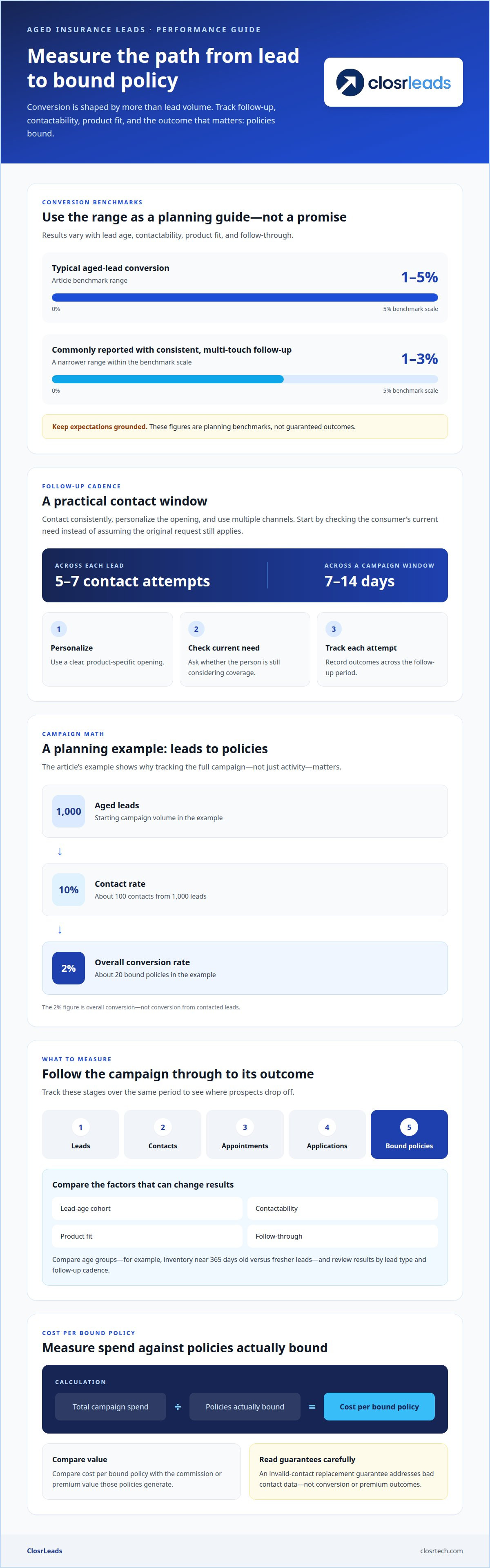
Contact consistently, personalize the opening, and track each stage from dial to bound policy. For aged insurance leads, the best strategies combine a clear product-specific message with repeated attempts across multiple channels. A practical cadence is 5 to 7 contact attempts per lead across a 7- to 14-day period. Use the first conversation to establish the consumer’s current need, not assume the original request still applies.
Conversion rates for aged insurance leads are typically 1-5%. Agents commonly report 1-3% with consistent, multi-touch follow-up. Treat those figures as planning benchmarks, not promises. Lead age, contactability, product fit, and follow-through all affect results. Track each factor separately. For example, compare outcomes by lead-age cohort, then check whether a group near 365 days old performs differently from fresher inventory.
Measure cost per bound policy, not just cost per lead. Divide total campaign spend by the policies actually bound, then compare the result with the commission or premium value those policies generate. A batch that creates conversations but no bound policies needs a different assessment from one that produces fewer calls and stronger closes. Track leads, contacts, appointments, applications, and bound policies over the same period.
A planning example shows how the math works: 1,000 aged leads, a 10% contact rate, and a 2% overall conversion rate produce about 20 bound policies. Your own tracking should show where prospects drop off, from unanswered calls to applications that don’t bind. An invalid-contact replacement guarantee addresses bad contact data, not conversion or premium outcomes. Review campaign results by lead type and follow-up cadence before increasing volume. That keeps decisions tied to bound policies rather than activity alone.
Final expense, Medicare, health, and IUL leads
Match lead age to the conversation rather than applying one rule to every product. A prospect who previously asked about Veteran Final Expense may still be interested, but their needs and circumstances can change. Start with a brief check-in and ask whether they’re still considering coverage. Avoid scripts that assume the person remembers the original inquiry or is ready to buy.
For life insurance leads, follow-up can remain relevant 90 to 180 days after the initial inquiry. A 30-day-old record and a six-month-old record call for different openings. Reference the original interest plainly, confirm whether the person’s goals have changed, and let the conversation guide the next step. The best aged insurance leads are those your team can connect to a useful, current coverage discussion.
Medicare leads need a different calendar. Medicare’s Open Enrollment Period runs from October 15 through December 7, while the Medicare Advantage Open Enrollment Period runs from January 1 through March 31. These dates shape when prospects may be reviewing coverage. Tailor outreach to the relevant period and the person’s stated interest. Health insurance conversations also benefit from a direct opening that confirms whether the consumer is still exploring options.
IUL leads call for a product-specific conversation about the prospect’s goals and interest in indexed universal life insurance. An older inquiry is not proof of current intent. Keep scripts focused on questions, not assumptions. Track outcomes by lead age and follow-up approach to see which methods lead to meaningful conversations and help qualified prospects move forward.
Match your next order to the product you’re prepared to discuss. Explore final expense and IUL leads to build a campaign around those insurance conversations.
ClosrLeads
ClosrLeads helps agents apply their lead strategy with real-time and aged insurance leads across relevant product types. Choose from Final Expense Leads, Veteran Insurance Leads, and IUL Leads to align prospecting with your sales focus. Each lead is OTP phone-verified and TCPA-compliant, and invalid contacts are covered by a replacement guarantee.
Leads are delivered the moment they come in to your CRM via webhook or CSV. The Built-in Dialer gives you a platform for working leads and supports a consistent process for follow-up and tracking conversations through to policy decisions.
Choose the lead type that fits your campaign and get started with ClosrLeads.
Put your next lead strategy into motion
Make your next campaign a deliberate test, not a guess. Choose a clear audience and product focus, then align your messaging and workflow before outreach begins. Give the team one shared definition of a qualified conversation, so lead outcomes can inform decisions instead of relying on impressions.
Use what you learn to refine the next campaign. If prospects respond to a particular opening or product angle, carry that insight forward. If conversations stall, review the message or follow-up process. Small, informed changes help agents build a repeatable approach and make future lead decisions with greater confidence.
The best aged insurance leads are the ones your team can work with purpose and learn from over time. Keep your process focused, let real conversations guide your next move, and build momentum one campaign at a time.
Contact ClosrLeads about aged leads to discuss your next campaign. Take the next step with a clear plan and keep moving forward.
Frequently Asked Questions
What are aged insurance leads, and how old are they typically?
Aged insurance leads are records of consumers who previously requested insurance information or a quote. They’re commonly 30 to 180 days old, though available records can span a wider age range. For example, an agent reviewing an older record should confirm whether the person’s coverage needs have changed before discussing options. Lead age describes when the inquiry occurred, not whether the consumer is still interested.
How much do aged insurance leads cost by insurance type and age?
Pricing depends on factors such as insurance type, lead age, exclusivity, and order filters. A specific order’s price follows a quote request. In general, compare the cost of a batch with its usable contacts and resulting bound policies, rather than judging by the cost per record alone. For instance, a lower-cost batch may still require more follow-up or produce fewer qualified conversations.
How do aged leads compare with real-time and exclusive insurance leads?
Aged leads come from earlier inquiries; real-time leads arrive closer to the consumer’s request. Exclusive describes distribution, not freshness: an exclusive lead is assigned to one agent, while an aged lead may be shared. Before placing an order, clarify both details separately. This helps you estimate how quickly to follow up and whether another agent may also contact the same prospect.
Which types of insurance perform best with aged leads, such as life, health, auto, or Medicare?
No single insurance type performs best for every agent. Product fit, lead age, consumer intent, and your follow-up process all matter. Life insurance inquiries may remain worth pursuing 90 to 180 days after the original request. Medicare outreach also needs to reflect the relevant enrollment period. Choose a lead type your team can discuss confidently, then assess results by product rather than combining every campaign.
What contact and conversion rates can agents expect from aged insurance leads?
Contact and conversion outcomes vary with record quality, lead age, product fit, and follow-up consistency. Use your own campaign results as the most relevant planning guide. Track calls answered, qualified conversations, applications, and policies bound as separate stages. For example, if calls connect but applications remain low, review the conversation and product fit before changing lead volume.
How can insurance agents evaluate lead quality before buying aged leads?
Evaluate a proposed order by its age range, insurance category, distribution terms, phone verification, and available consent records. Ask how invalid contact issues are handled and whether the order’s filters match the states and products you work. Start with a batch your team can follow through, then record connection and policy outcomes. That evidence helps guide later purchasing decisions without relying on assumptions.