Blog
Close More Insurance Deals by Matching Client Needs to Quotes
Learn how to close more insurance deals by matching quotes to client needs. Discover effective sales strategies, objection handling, and qualification tips.

To close more insurance deals, match each quote to the client’s coverage needs, liabilities, budget, and priorities. Start by identifying what they want to protect and what information is needed to assess the risk. Then explain how the proposed coverage fits, so the client can compare the quote with confidence.
Price matters, but it’s only part of the decision. Clients also need to understand what a policy covers, its limits, and how its costs fit their circumstances. A quote that addresses those concerns gives the conversation a clear purpose and helps avoid recommending coverage that doesn’t suit the client.
This article explains how to assess insurance needs and liabilities, gather details for a suitable quote, and present options clients can evaluate. You’ll also learn how to handle common objections while keeping the client’s protection needs in view. The result is a focused sales conversation built on fit, not pressure.
Key Takeaways
- Match a quote to the client’s coverage needs, liabilities, budget, and priorities, then make the fit easy to understand.
- Qualify prospects by clarifying what they want to protect, what matters in their decision, and what could affect their readiness to move forward.
- Ask focused questions about existing coverage, changing circumstances, and concerns before preparing a quote.
- Address price objections by explaining the trade-offs; a higher deductible can lower premiums, but clients should be able to afford the out-of-pocket cost of a claim.
- Keep follow-up relevant to the conversation, and see how insurance leads and a built-in dialer can support your sales workflow.
What sales techniques help insurance agents close more deals?
To close more insurance deals, make your recommendation about the client’s needs, not a product pitch. Ask what they want to protect, what coverage they already have, and what has changed. A new vehicle, a growing family, or a business expansion can shift the risks they need to consider. Listen for the concern behind the request, then explain how the proposed policy addresses it. An agent helps customers assess their coverage needs and find a policy that suits them.
Have a needs-based conversation before discussing a quote. Separate essential protections from preferences, and clarify what the client could afford to pay if a claim occurs. For example, a driver seeking a lower premium might consider a higher deductible, but that only fits if they can manage the larger out-of-pocket payment after a claim. Explain the trade-off plainly. Don’t present a cheaper premium as a better fit unless the coverage and deductible suit the client’s situation.
Make coverage limits understandable with a concrete example. Ask what the client understands about each limit, then explain how those limits relate to their exposure. Clear explanations help clients compare protection, not just the premium at the top of a quote.
Present quotes on a like-for-like basis. Compare coverage limits, premiums, deductibles, and policy features, then explain meaningful differences. If a client has multiple policies, discuss whether bundling with one insurer may save money. Ask about discounts that might apply, such as safe-driving, good-student, military, or multi-policy discounts. Eligibility depends on specific criteria, so explain the relevant requirements rather than implying everyone qualifies.
Close with a concise recap and a clear decision point. Summarize the client’s main concern, the coverage chosen to address it, the deductible, and any significant exclusions or limits. Then ask what needs clarification. If the client hesitates over price, revisit the deductible and coverage trade-offs without pressuring them to accept protection they can’t afford. If they’re concerned about a coverage gap, show how the quote addresses it. A focused recap keeps the discussion grounded in the client’s priorities and gives them a practical basis for deciding.
How can insurance agents qualify leads and identify buying signals?
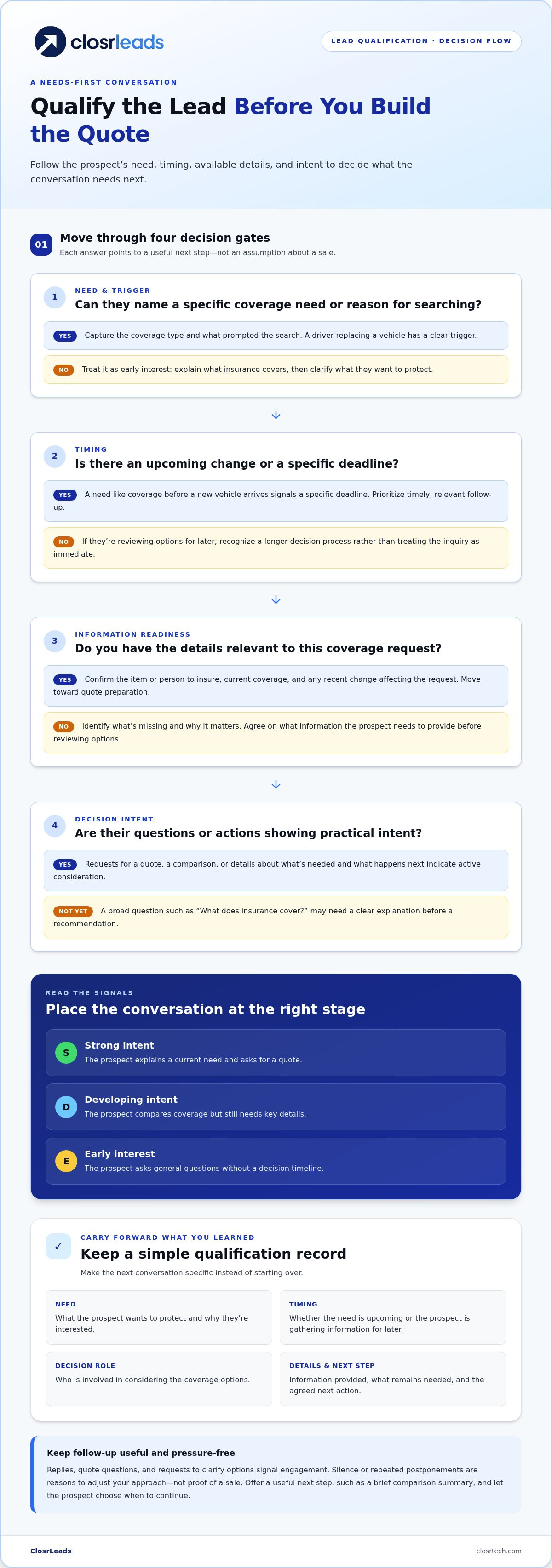
Qualify a lead by assessing fit, intent, timing, and readiness to share details. Start with the coverage type the prospect wants, then ask what prompted their search. A driver replacing a vehicle has a clear trigger; someone browsing without a specific concern may need more information first. Record the reason for interest so your next conversation responds to the prospect’s situation.
Next, clarify timing. Ask whether the person is comparing options for an upcoming change or gathering information for later. “I need coverage before my new vehicle arrives” signals a specific deadline. “I’m reviewing options for next year” suggests a longer decision process. This distinction helps you prioritize timely follow-up without treating every inquiry as an immediate purchase.
Assess decision readiness through the prospect’s questions and actions. Someone asking what information is needed for a quote, how coverage limits differ, or what happens after selecting a policy is showing practical intent. A request to compare two options is another useful signal. By contrast, a broad question such as “What does insurance cover?” may call for an explanation before a recommendation.
Assess whether you can move the conversation forward. Confirm the details relevant to the coverage type, such as the item or person to insure, current coverage, and any recent change affecting the request. If a prospect can provide those details and agrees to review options, proceed with quote preparation. If key information is missing, identify what is needed and why it matters.
Keep a simple qualification record after each conversation. Capture the prospect’s need, timing, decision role, information provided, and agreed next action. For example, note that a prospect wants to compare coverage before buying a vehicle, needs to locate current policy details, and prefers follow-up after reviewing them. This makes the next contact specific instead of restarting the conversation.
Buying signals also show up in a prospect’s engagement. Replies that answer follow-up questions, requests to clarify a quote, and practical questions about next steps indicate active consideration. Treat silence or repeated postponements as reasons to adjust your approach, not as proof of a sale. Offer a useful next step, such as a brief comparison summary, then let the prospect choose when to continue.
- Strong intent: The prospect explains a current need and asks for a quote.
- Developing intent: The prospect compares coverage but still needs key details.
- Early interest: The prospect asks general questions without a decision timeline.
For a more organized prospecting workflow, explore insurance lead qualification options alongside your own intake process. When a prospect compares options but has not settled on timing or supplied every detail, you can guide them further. For U.S. Marketplace applicants, eligibility for cost-sharing reductions becomes clear after applying and checking the Eligibility Determination Notice. A notice followed by code (04), (05), or (06) indicates qualification for income-based savings, which require choosing a Silver plan. Within the qualifying range, lower income means greater savings.
Someone with a Silver plan who loses cost-sharing reductions qualifies for a Special Enrollment Period. Customers can ask their insurer which discounts are available or compare quotes from other insurers to identify discounts and help close more insurance deals.
What questions should insurance agents ask during a sales conversation?
Open with the event that brought the client in. Ask, “What changed that made you look at coverage today?” A new job, a move, a vehicle purchase, or a family change can point to different needs. Follow with, “What are you most concerned could happen?” This helps distinguish the client’s main risk from a general request for a quote.
Then map the existing protection. Ask, “What coverage do you already have, and what does it protect?” Invite the client to describe a recent policy review or claim that changed their priorities. For example, someone who found a previous policy confusing may value a clear explanation of limits and exclusions. Ask what they would keep, change, or remove, and record the answer in their own words.
Clarify the exposure before collecting quote details. Ask who or what needs protection, how it is used, and whether circumstances have changed. A trucker, for instance, may need to explain the vehicle’s use and operating situation. A veteran considering life coverage may want to discuss who depends on their income and what support they want to provide. These questions connect the quote to the client’s circumstances.
Explore priorities with questions that invite comparison rather than a yes-or-no answer. Try, “Which matters most to you: broader protection, predictable costs, or flexibility?” Then ask, “What would make this option feel like the right fit?” One client may prioritize keeping a particular feature, while another may want to understand how a claim would affect them. The answer shapes the conversation without assuming every prospect values the same things.
- For clarity: “Which term or feature would you like me to explain first?”
- For concerns: “What part of choosing coverage feels uncertain?”
- For decision roles: “Who else should be part of reviewing this recommendation?”
Before preparing a quote, confirm the details the client shared. Summarize the requested coverage, relevant circumstances, and stated priorities, then ask, “Have I understood that correctly?” This catches mismatches early. If a client wants to protect a family member but the requested coverage doesn’t reflect that goal, pause and clarify the intended benefit before proceeding.
Finish by agreeing on a clear next step. Ask whether the client wants to review the quote together, discuss specific terms, or gather more information first. For example, if a prospect needs to locate an existing policy, record that as the next action. Specific questions produce usable answers, making the recommendation more relevant.
Agree on how to continue once the information is available. Make the follow-up purposeful: return to the client’s priorities, explain relevant terms, and check that the proposed coverage still matches the need they described. Insurance customers should review their policies regularly to confirm that their coverage remains appropriate and that they are receiving competitive rates. Use that review to ask what has changed and whether the client wants to reassess their protection. Keep the conversation focused on their goals, not just a routine renewal.
How can agents overcome common insurance sales objections
Treat an objection as information, not rejection. If a client says, “I’m not sure this is right,” ask what feels uncertain. They may be concerned about the premium, a policy feature, or whether the coverage fits their situation. Reflect the concern in plain language, then address it directly. For example: “You want to understand what this option protects before deciding.” This keeps the discussion focused on the client’s hesitation.
For a price objection, find out whether the concern is the premium or the overall value. If the premium feels too high, explain that raising a deductible can lower premiums, but the client should be able to afford the higher out-of-pocket payment if they make a claim. Ask what they could comfortably pay after a loss. Then discuss whether changing the deductible still provides a suitable fit. Don’t push a cost reduction that creates a burden the client can’t manage.
When a client says, “I need to think about it,” don’t force an immediate decision. Ask what information would help them evaluate the option. They may want a clearer explanation of a term or time to discuss the decision with someone else. Offer a concise summary of the coverage, their main concern, and what they still need to resolve. Agree on a relevant follow-up instead of repeating the same pitch.
When a client says, “I already have coverage,” acknowledge that their existing protection may meet their needs. Ask what they value in their current policy and what prompted them to review it. If they mention a recent change, explore whether it affects their priorities. The goal isn’t to create doubt about an existing policy. It’s to identify whether the client has a specific question or wants to compare options based on their circumstances.
- “I don’t understand the terms.” Explain the specific term in everyday language, then ask the client to describe what remains unclear.
- “I’m not ready.” Ask what needs to happen before they can continue, such as gathering policy details or consulting a family member.
- “I’m comparing options.” Ask which features matter most, then clarify how the proposed option addresses those priorities.
Some objections reveal a genuine mismatch. If the client’s budget, priorities, or needs don’t align with the proposed option, say so plainly and revisit the requirements. The best response may be to pause, gather missing details, or explain why the recommendation doesn’t address the concern. A straightforward answer protects trust and gives the client a clear reason to continue when the fit is better understood.
Close the objection conversation with a specific check-in: “Have I addressed your concern about the deductible, or is another part still unclear?” The answer tells you whether to clarify, adjust the discussion, or give the client space. A respectful response handles objections without pressure and keeps the decision grounded in the client’s needs.
What follow-up schedule converts insurance leads without being pushy
A useful follow-up schedule follows the prospect’s decision process, not an arbitrary string of reminders. Agree on the next contact during the conversation. If someone needs to find an existing policy, follow up after they’ve had time to locate it. If they’re comparing a quote with a family member, ask when they expect to discuss it. Their answer gives your next contact a clear purpose.
After the initial conversation, send a concise recap through the contact method the prospect prefers. Include the coverage question they raised, the information still needed, and the agreed next step. For example, if a prospect is reviewing truck coverage and needs to clarify vehicle use, identify that detail in the recap. Avoid a generic “just checking in” message; it gives the prospect no useful reason to respond.
Use each follow-up to move the conversation forward:
- After the first discussion: Share the promised summary or answer, then invite the prospect to correct any misunderstanding.
- When information is outstanding: Name the specific detail needed, such as current policy information, and explain how it helps prepare a relevant quote.
- After presenting an option: Ask which feature or term the prospect wants clarified before making a decision.
- If the prospect is not ready: Ask when it would be useful to reconnect, then respect the timing they give.
Adjust your message as the conversation develops. If a prospect asks about a deductible, make the next contact about that trade-off. If they’re concerned about a coverage term, explain it plainly. A client considering veteran coverage may need a different discussion from a trucker reviewing commercial vehicle needs. Personalizing the reason for contact makes follow-up relevant rather than repetitive.
Track every interaction in one record. Note the conversation date, the prospect’s stated preference, the question discussed, and the agreed next action. If a prospect says they’re waiting for a document, record that instead of restarting the sales pitch. A clear record also helps prevent multiple agents from contacting the same person with conflicting messages.
When a prospect doesn’t respond, send one brief, useful message referring to your last exchange. For example: “You mentioned wanting to review the coverage limits. Would a plain-language comparison help?” If there’s still no reply, pause instead of escalating contact without a reason. Resume when the prospect responds, requests another conversation, or a relevant event gives you a new reason to reach out.
Close the loop when a prospect declines or asks you to stop. Acknowledge the decision, update your records, and end the sales sequence. Consistent timing, useful messages, and respect for the prospect’s preferences create a disciplined follow-up process without turning persistence into pressure.
ClosrLeads: Final Expense Leads
ClosrLeads supports agents prospecting for final expense conversations with real-time and aged Final Expense Leads. All leads are OTP-verified and TCPA-compliant, with documented consent records. A replacement guarantee applies to disconnected, wrong-number, or invalid contacts per policy. The built-in dialer delivers leads directly into users’ CRM systems, supporting follow-up and client conversations.
Agents can also explore Veteran Final Expense and IUL leads when those verticals fit their target markets. These leads support prospecting in those areas, while needs-based questions and a considered quote process guide each individual conversation. ClosrLeads supports lead acquisition and follow-up workflow; agents remain responsible for assessing prospects’ needs and discussing suitable coverage.
Contact ClosrLeads to explore its insurance lead options.
Make your next client conversation count
The next opportunity to close more insurance deals starts before you present another quote. Treat your sales process as a learning loop. After each conversation, note which question uncovered the client’s priority, what made the recommendation clear, and where hesitation remained. Use those observations to improve your next discussion, not to push every prospect toward the same decision. Better conversations come from applying what each client teaches you.
When your next step is strengthening your prospect pipeline, match the lead type to the conversations you want to have. ClosrLeads offers Final Expense Leads, Veteran Final Expense leads, and IUL leads. Review your sales goals and see whether these options fit your workflow.
Contact ClosrLeads to discuss your goals. Keep listening, keep refining, and let each client conversation move your process forward.