Blog
Common Insurance Lead Generation Scams and Their Warning Signs
Learn how common insurance lead generation scams use bots, recycled data, misleading traffic, and false consent claims—and what to check before you buy leads.

A polished lead file can still come from a bad source. Common insurance lead generation scams conceal how prospect information was collected, using bot submissions, recycled or aged data, misleading traffic sources, or false consent claims. The result can be wasted spend, lower conversion, and compliance risk.
Paying for leads that don’t match their description is frustrating, and the warning signs aren’t always clear from a name and phone number alone. This article explains how bot-generated submissions differ from genuine inquiries, how reused or old leads may be presented as fresh, and how misleading traffic sources or false consent claims can expose a problem. You’ll learn what details to review to see whether a lead’s origin, age, and consumer disclosures match the seller’s description.
Key Takeaways
- Recognize signs that a submission may be automated, and understand why suspicious patterns can undermine lead quality.
- Assess how lead age and repeated data affect follow-up, contact rates, and the value of a prospect record.
- Trace misleading traffic claims to the gap between where an ad appears and where a lead actually originates.
- Know which details about collection time, source, and consumer disclosures help expose misrepresented leads.
Bot-generated submissions
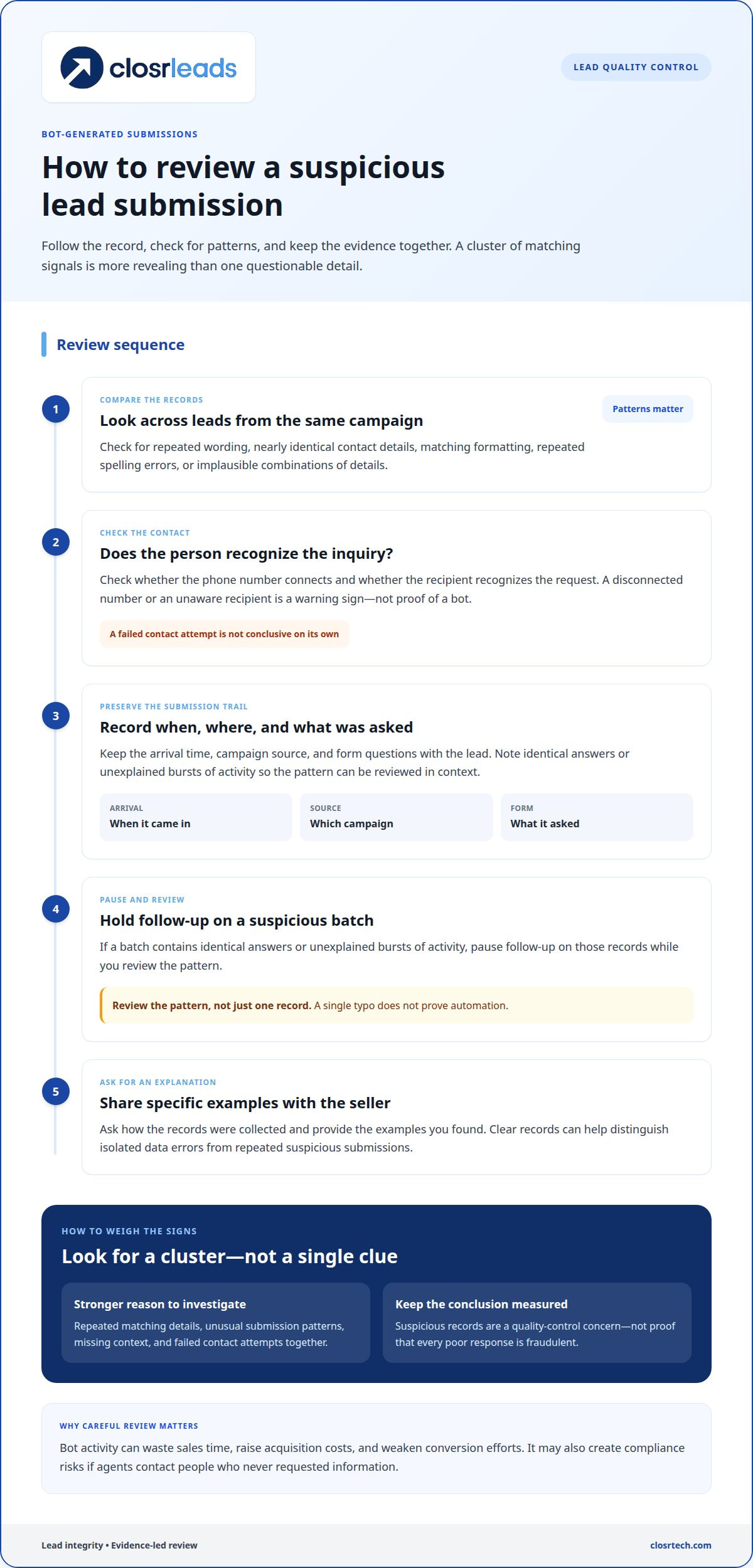
Bot-generated submissions imitate genuine quote requests by filling online forms with names, phone numbers, and coverage details. Some look plausible at first glance. Repeated records with identical wording, nearly identical contact details, or unusual submission patterns deserve closer review. One typo doesn’t prove automation; a cluster of matching signals is more revealing.
Consumers can reduce the risk of quote and lead-generation scams by confirming an agent’s license through their state department of insurance website. Be cautious about unusually attractive offers, especially on social media, and contact the insurer named on policy documents to confirm a policy’s validity.
For agents, start with the records. Compare a questionable submission with other leads from the same campaign. Several entries arriving close together with the same formatting, repeated spelling errors, or implausible combinations of details may indicate automated activity. Check whether the phone number connects and whether the person recognizes the inquiry. A disconnected number or an unaware recipient is a warning sign, not proof of a bot.
Keep your review tied to the source and submission trail. Record when each lead arrived, which campaign generated it, and what the form asked. If a batch contains identical answers or unexplained bursts of activity, pause follow-up on those records while you review the pattern. Ask the seller to explain the collection method and address specific examples. Clear records help distinguish isolated data errors from repeated suspicious submissions.
Bot activity can waste sales time, raise acquisition costs, and weaken conversion efforts. It may also create compliance risks if agents contact people who never requested information. Treat suspicious records as a quality-control issue, not proof that every poor response is fraudulent. Consistent patterns, missing context, and failed contact attempts together provide stronger grounds to raise concerns about possible lead-generation fraud.
Lead age and data reuse
A lead’s age indicates how recently someone expressed interest. Reuse means the same record reaches multiple buyers or reappears in later batches. An older record isn’t automatically fraudulent; the problem arises when its age or prior distribution conflicts with the seller’s description.
Exclusive leads go to one buyer, shared leads go to multiple buyers, and aged leads were collected earlier. Exclusive leads can reduce competition for the same prospect, while shared leads may result in several calls. Aged leads may reflect less current intent. Price depends on these factors and the seller’s terms, so compare the promised lead type with what you receive.
To spot recycled records, compare new submissions with existing CRM entries. Look for matching phone numbers, email addresses, names, or inquiry details. A familiar contact may have submitted another request, so a match alone doesn’t prove misconduct. Check the collection date and campaign source before deciding whether the lead was improperly resold.
For example, a buyer expecting a fresh inquiry may receive a record that already appears in an older campaign. Repeated submissions with identical contact information but different delivery dates warrant closer review. Keep the records and ask the seller to explain the collection date, lead age, and whether the lead was shared. Specific examples make a dispute easier to assess.
Look for hidden-fee warning signs in the billing terms: vague charges, add-ons not disclosed before purchase, or invoices that don’t match the agreed lead type and quantity. Request an itemized explanation through the vendor’s account channel and compare it with your order records. Charges should be clear before you buy.
For suspected insurance fraud, victims can contact the National Insurance Crime Bureau at 800.835.6422. A dispute over recycled lead data is different; preserve the records, dates, and billing details, then raise the issue through the vendor’s account channel. This evidence can help distinguish an honest data match from a misleading sale.
Misleading traffic sources
A traffic source is the place or campaign that brings someone to a lead form. A seller might describe a submission as coming from a direct insurance quote page, while the consumer first encountered a social media ad. That distinction matters. The ad’s promise, the page’s purpose, and the form’s questions shape what the person believes they requested. A mismatch can leave agents calling people who expected something else.
Clickbait-style ads on low-cost websites and social media can be warning signs associated with ghost brokers. These operators may use fictitious websites, social media, or word of mouth to promote unusually cheap insurance premiums. A striking headline might promise an effortless quote, then direct visitors to a form that collects contact details for a different purpose. The lead’s apparent interest may not match the offer that generated it.
Even reputable partners can inadvertently buy leads from sources that use deceptive tactics. A familiar partner name alone doesn’t reveal the original traffic source. For example, a lead may pass through several marketing relationships before reaching an insurance buyer. Each handoff can obscure whether the consumer saw an insurance-specific offer, a general savings message, or an unrelated promotion.
To assess a traffic-source concern, compare the seller’s description with the actual path. Ask for the campaign or publisher source, the landing-page content, and the consumer-facing offer associated with the submission. Then compare those details with the lead’s stated interest. If a seller calls a record an insurance quote request but its source promoted a generic giveaway, ask for an explanation. Keep the record and seller’s description together.
Traffic problems can affect more than response rates. A misleading offer can cause confusion and complaints, and leave you unsure whether someone intended to hear from an insurance agent. Treat a source mismatch as a reason to investigate, not proof of fraud on its own. A clear account of the ad, website, and form gives buyers a stronger basis for assessing lead quality and raising specific concerns about how the submission was generated.
Misrepresentation of how leads are obtained
Lead-generation fraud includes concealing or falsifying a lead’s source, age, authenticity, offer, or collected data. A polished record can still misrepresent what the consumer saw or agreed to.
False Consent Claims and TCPA Violations
False consent claims arise when a seller misstates or fabricates how a consumer agreed to be contacted. A form might hide its disclosures, or a seller might claim consent without showing what the consumer saw. This matters because agents may contact people who never knowingly requested insurance information. Buyers need the actual form and consent details tied to each lead, not just the seller’s assurance.
Verifying Vendors and Lead Sources
Vendor verification means comparing the seller’s claims with the lead’s collection record and consumer-facing form. Ask for the exact collection time and location, the offer and disclosures shown, and the traffic source. Compare these details with the lead data and campaign description. If a vendor can’t explain a mismatch, buyers can’t properly assess authenticity, consent, or whether the lead was accurately represented.
Check the path from advertisement to submission. If a lead is described as an insurance quote request, its form should support that description. Compare the submitted information with the original record, including the date, source, and stated interest. A missing disclosure or a generic offer presented as an insurance-specific request can reveal a gap between the seller’s claim and the consumer’s experience.
Keep the evidence together: the vendor’s description, lead record, form, and consent disclosure. If the vendor says the person opted in through a particular offer, those materials should tell a consistent story. Raise specific discrepancies with the seller and keep its explanation. This review helps identify false claims without treating every incomplete record as proof of fraud.
Lead buyers may be unable to verify what the consumer saw, how consent was obtained, when a lead was submitted, or where it originated. Lead sellers may offer lower-quality data as premium, real-time opt-in leads because they can profit from doing so. The poster reported that about 98 percent of the purchased leads were already on his USAdata list.
To reduce uncertainty, lead buyers should verify the exact time and location where each lead was collected, the form and consent disclosures shown to the consumer, and the authenticity of the submitted data.
ClosrLeads
ClosrLeads offers real-time and aged insurance leads across several insurance categories. Its leads are OTP phone-verified, and invalid contacts are covered by a replacement guarantee. These features can support agents seeking clearer contact validation and a defined process for invalid records, but they don’t replace reviewing lead source, age, and consumer disclosures.
Agents can choose Final Expense, Veteran, IUL, Trucker, or Mortgage Protection Leads based on their sales focus. A Built-In Dialer delivers leads into users’ CRM systems for follow-up. If you’re refining how leads enter your pipeline, review the options that fit your workflow and campaign needs.
Contact ClosrLeads to discuss insurance leads for your business.
Make lead quality part of your growth plan
Make lead review a regular part of your sales process. Clear records help your team respond with confidence, spot patterns sooner, and make better decisions about which sources to keep investing in. Set a consistent standard for documenting lead details and resolving concerns. That discipline can protect your time and keep your pipeline focused on genuine consumer interest.
Common insurance lead generation scams are easier to manage when you make source transparency and record quality part of your buying decisions from the start. Set those expectations, then choose a lead program that fits your insurance focus and workflow.
Ready to take the next step? Discuss your lead strategy with ClosrLeads and move forward with a clearer plan.
Frequently Asked Questions
What is lead generation fraud?
Lead-generation fraud occurs when a provider falsifies or conceals how a prospect record was created or collected. For example, a seller might describe a lead as a fresh insurance inquiry even though the person previously submitted information for a different offer. The key issue is the gap between the seller’s claims and the record’s actual source, age, offer, or consumer-provided details.
What are the most common insurance lead generation scams in the U.S.?
Common insurance lead generation scams include automated form submissions, recycled records sold as new, misleading ads or traffic sources, and false claims about consumer consent. For example, you might receive a supposed insurance inquiry from someone who never saw an insurance offer. Compare each lead with the seller’s description, and keep clear records of questionable submissions to support follow-up and dispute resolution.
Where can victims report insurance lead scams in the U.S.?
People who suspect insurance fraud can contact the National Insurance Crime Bureau by calling 800.835.6422. For a dispute over recycled lead data, preserve the records and raise the issue through the vendor’s account channel.