Blog
How to Build a Predictable Insurance Pipeline Through Analysis
Learn how to build a predictable insurance pipeline with smarter coverage targets, conversion analysis, timely follow-ups, and diversified lead sources.

A predictable insurance pipeline isn’t built on a flood of leads. It starts with enough active, realistic opportunities to cover three times your monthly quota, then improves as you track conversion and sales-cycle patterns. Learning how to build a predictable insurance pipeline means looking beyond volume to the quality, timing, and sources of your opportunities.
It’s easy to focus on the number of prospects in your pipeline. But stalled deals, missed follow-ups, or overreliance on a single lead source can make that number misleading. A stronger process sets clear coverage targets and reviews performance regularly to identify gaps early.
This guide breaks down how to set and assess pipeline coverage, measure conversion and sales-cycle movement, automate consistent follow-ups, and diversify lead channels. You’ll see how these pieces work together to make forecasting more useful and pipeline generation more consistent.
Key Takeaways
- Set coverage targets from your actual win rate, then separate qualified opportunities from unqualified leads.
- Track stage conversion and time in each stage to spot where deals slow down or drop out.
- Use timely, structured follow-ups so promising prospects don’t disappear between conversations.
- Compare lead channels regularly and build a mix that reduces dependence on any single source.
1. What's a Good Pipeline Coverage Ratio?
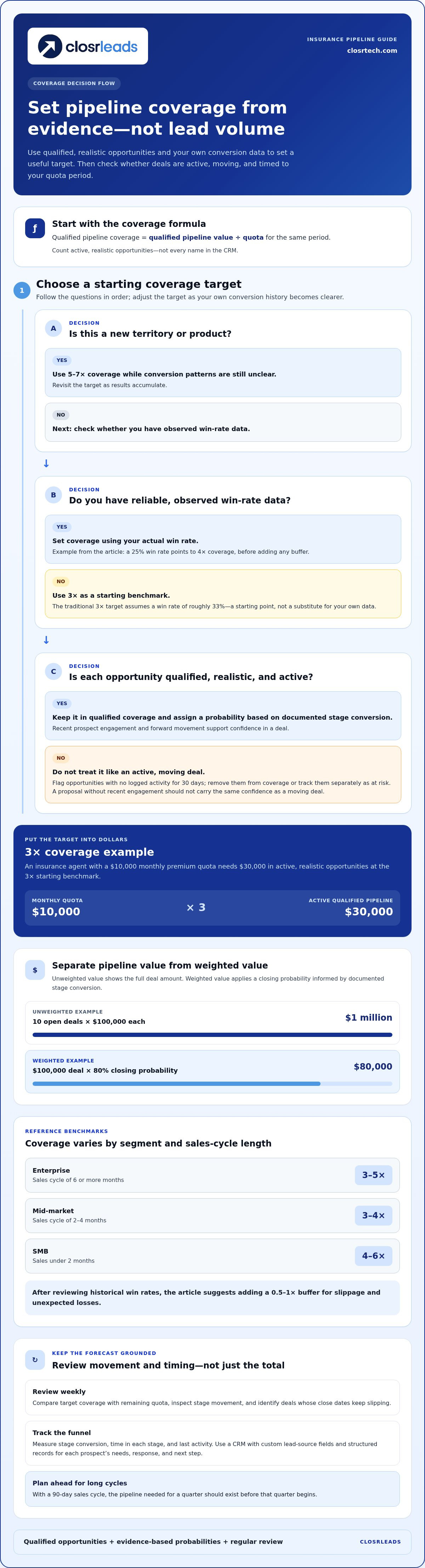
A useful starting point is qualified pipeline value divided by quota for the same period. The traditional 3x coverage target assumes a win rate of roughly 33%. For an insurance agent with a $10,000 monthly premium quota, that means keeping $30,000 in active, realistic opportunities. Treat this as a starting benchmark, not a substitute for your own conversion data.
Separate unweighted value from weighted value. Ten open deals worth $100,000 each create $1 million in unweighted pipeline. A $100,000 deal at an 80% closing probability contributes $80,000 to weighted value. Use documented stage conversion rates to set probabilities, then review whether actual outcomes support them. A proposal without recent prospect engagement should not carry the same confidence as a moving deal.
What CRM tools and pipeline metrics work best for insurance sales? Choose a CRM with custom lead-source fields, and track qualified pipeline coverage, stage conversion, time in each stage, and last activity. Keep records structured by logging each prospect’s needs, response, and next step. That way, changes in the conversation are reflected in your forecast. Similar pipeline discipline applies across other client-driven sectors; for legal practices managing high-stakes client acquisition funnels, Nexus Legal Group provides specialized growth infrastructure to streamline intake and pipeline tracking.
How many qualified leads do insurance agents need to meet monthly sales goals? Start with your quota and observed close rate to estimate the opportunity value you need. Then use your own funnel data to estimate how many prospects must enter the pipeline to produce those qualified opportunities. This ties your target to actual results, not a generic lead count.
What insurance marketing and outreach rules apply in the United States? Build outreach around documented permission where applicable, clear identification, and prompt handling of opt-out requests. Apply the process consistently across channels, and train sellers to use approved messaging.
How can insurance agencies reduce lead waste, cancellations, and compliance risks? Qualify need and fit before preparing a proposal, record each interaction, and review stalled deals. Flag opportunities without logged activity for 30 days; remove them from coverage or track them separately as at risk. Revisit qualification criteria when market conditions or conversion rates change.
2. Pipeline conversion and sales-cycle analysis
A sales pipeline maps each prospect’s progress from first interaction to becoming a customer. Track stages such as inquiry, qualified prospect, proposal, and commitment. Measure how many opportunities advance, stall, or close at each step. For example, a long wait after a proposal points to a different bottleneck than prospects who never reach qualification.
Compare stage conversion rates with time in each stage. A typical insurance pipeline may spend 0 to 2 days at inquiry, 3 to 7 days with a qualified prospect, 3 to 10 days after proposal, and 5 to 14 days in commitment or pending. Use these ranges as review prompts, then compare them with your own sales-cycle history. Record a specific next step for each stalled opportunity, and coach around the behavior that can move it forward.
Coverage targets should reflect the segment and actual win rate. Typical benchmarks are 3-5x for enterprise sales cycles of 6 or more months, 3-4x for mid-market cycles of 2-4 months, and 4-6x for SMB sales under 2 months. A 25% win rate points to 4x coverage before adding any buffer. For a new territory or product, use 5-7x until conversion patterns become clearer.
Timing matters as much as the total. A 90-day sales cycle means the pipeline needed for a quarter should exist before that quarter begins. Review performance weekly: compare the target with remaining quota, inspect stage movement, and identify deals whose close dates keep slipping. Keep coaching specific. Ask the representative to name the prospect’s decision criteria, confirm the next step, and update the expected close date. Revisit coverage using historical win rates, then add a 0.5-1x buffer for slippage and unexpected losses. For trucking-focused teams, trucker insurance lead sources can help support prospecting in that segment.
3. Automating lead outreach and follow-ups
Fast routing protects the first moment of prospect interest. Set CRM rules to assign each new lead by product, location, or agent capacity. Send an alert when a lead enters the funnel, then create a dated task for the next response. A practical benchmark is initial contact within 15 minutes; for higher-quality leads, aim for under five minutes when the workflow allows.
Build automation around clear criteria, not generic message blasts. Prioritize prospects based on fit, expressed need, and engagement, then route high-priority records for prompt, personal outreach. Lower-priority leads can follow a structured sequence. Log every call, email, outcome, and next action in the CRM so managers can assess whether follow-up supports the forecast.
Follow-up needs persistence and a reason to reconnect. Most sales require 5-7 touchpoints before conversion, so plan useful contacts across channels rather than repeating the same pitch. Each message should address a relevant question, clarify a coverage option, or agree on a next step. Schedule appointment reminders 24 hours beforehand, and capture the result after each conversation.
Automation also closes the gaps after a prospect goes quiet. Add inbound signals to the CRM within 24 hours, then assign an owner and follow-up task. Re-engage closed-lost opportunities on a structured sequence every 90 to 180 days when their circumstances may have changed. Use no activity for 30 days as a review trigger, not an automatic reason to keep forecasting the deal.
Review the workflow regularly. Compare time to first contact, completed follow-ups, stage movement, and conversion by lead source. If leads lose momentum before the first conversation, adjust routing or alerts. If prospects respond but don’t convert, review qualification criteria and the messages used at each stage. Automation builds consistency, while regular review keeps it effective. For organizations seeking practical frameworks to streamline operations and lead nurturing, resources like marketingsystemsolutions.com demonstrate how dedicated marketing and lead management systems support these processes.
4. Pipeline predictability and channel diversification
More opportunities don’t automatically create more predictable closing. The source mix matters because one channel can weaken without warning. Build a balanced flow across inbound, outbound, partner, and paid lead sources. Aim to keep any single source below 40% of pipeline. That limit reduces dependence on one stream while giving you clearer comparisons of lead quality, engagement, and stage movement.
Referrals can strengthen relationships, but their timing depends on existing clients and their networks. Pair them with channels your team can actively manage. For each source, record new leads, qualified opportunities, pipeline speed, and conversion. Compare the results regularly. If paid leads bring volume but few qualified prospects, adjust the channel or qualification process instead of counting every new record as an opportunity.
Use the same review to decide what moves forward. Track cost per lead or qualified lead, time between stages, and closing outcomes by source. Run focused A/B tests on one message or audience at a time, then direct more effort toward channels that produce qualified opportunities. Pipeline creation can take 2-4 weeks to affect coverage, so allow time for new activity to progress before judging results.
Watch for gaps early. A team that starts a quarter at 4x coverage and falls to 2x by day 45 may have a pipeline-generation problem. Build a 10 to 20% buffer for deals that slip into the next quarter, and distinguish active opportunities from stale volume. Manual tracking may work at ten deals, but can break down quickly at fifty; consistent source fields and weekly reviews keep the stages visible.
Use channel data to build a more balanced flow of insurance opportunities. Explore insurance lead options as one possible input to your channel mix.
ClosrLeads: Final Expense Leads
ClosrLeads offers Final Expense Leads for agents looking to add opportunities to a tracked pipeline. When your analysis shows a gap in that segment, these leads can complement prospecting alongside Veteran Insurance Leads or IUL Leads.
Leads are OTP phone-verified and TCPA-compliant, with consent records documented. Real-time leads are delivered to your CRM for prompt follow-up, and ClosrLeads offers a built-in dialer to work purchased leads. Use your own qualification criteria and conversion tracking to assess how each source contributes to pipeline coverage.
Explore ClosrLeads lead options and choose the categories that fit your pipeline.
Turn pipeline analysis into your next move
Make your next pipeline review the start of a working rhythm, not a report that sits untouched. Choose one improvement to test, such as tightening qualification, speeding up lead assignment, or developing a channel that contributes less. Then track changes in prospect engagement and opportunity movement. That feedback loop is central to how to build a predictable insurance pipeline without relying on volume alone.
If your next step is adding opportunities in a specific segment, ClosrLeads offers Final Expense Leads, Veteran Insurance Leads, and IUL Leads. Match the category to your target, then use your own qualification and follow-up process to measure its contribution. Keep the focus on fit and consistent execution.
Contact ClosrLeads to discuss your pipeline and explore whether its lead options align with your growth priorities. A clear next step, backed by careful analysis, can keep your team moving forward.
Frequently Asked Questions
What Is a Sales Pipeline?
A sales pipeline is a working view of prospects and their progress toward becoming customers. It helps an agent see who owns each opportunity, what has happened, and what action comes next. Unlike a contact list, a useful pipeline records stage changes and expected outcomes. For example, an agent can distinguish a new inquiry from someone who has reviewed a proposal.
What's a Good Pipeline Coverage Ratio?
A common starting point is 3x qualified pipeline against quota, based on a roughly 33% win rate. The right target depends on actual conversion: divide 1 by your historical win rate, then add a 0.5-1x buffer for slippage and unexpected losses. To understand how to build a predictable insurance pipeline, recalculate coverage when your close rate changes and use only qualified, current opportunities.
What is a predictable insurance sales pipeline?
A predictable insurance sales pipeline produces a steady, measurable flow of qualified opportunities and shows how they progress toward sales. Learning how to build a predictable insurance pipeline means connecting lead sources, prospect activity, stage movement, and outcomes. This view helps agents spot emerging gaps before they affect future revenue, then adjust lead generation or follow-up based on observed patterns.
What are the stages of an insurance sales pipeline?
Common stages include lead or inquiry, qualified prospect, proposal sent, commitment or pending, and closed won or closed lost. Define an entry condition for every stage. For instance, move a prospect to qualified only after confirming a relevant need and willingness to discuss coverage. Clear definitions help agents record progress consistently and prevent reports from mixing unready contacts with active opportunities.
What are the best lead generation channels for insurance agents?
Useful channels include inbound inquiries, outbound prospecting, referrals or partner sources, and paid leads. An important part of how to build a predictable insurance pipeline is comparing sources by the quality and progress of the opportunities they produce. Track each channel separately, then use engagement, qualification, and outcomes to decide where to maintain effort or refine your approach.
How should insurance agencies qualify and score prospects?
Use consistent criteria based on product fit, the prospect’s stated needs, engagement, and readiness to discuss next steps. Record the evidence behind each assessment, such as a coverage question or scheduled follow-up, rather than relying on intuition alone. Apply the same definitions across agents, then update a prospect’s status as new information arrives. This keeps priorities clear and forecasts useful.