Blog
How to Build Final Expense Prospecting Scripts for Better Conversations
Build final expense prospecting scripts with natural openers, health and budget questions, and flexible objection responses for more productive conversations.

A script that sounds like a pitch can shut down a conversation before it starts. Strong final expense prospecting scripts give prospects room to explain what matters, then guide the discussion toward a relevant next step. A clear structure helps you stay focused without making the call feel mechanical.
A polished opener alone won’t make a conversation productive. You also need curiosity-based questions, a respectful way to discuss health and budget, and calm responses when someone says they’re busy, already covered, or not interested. Build each part around the prospect’s answers, connect those answers to a useful presentation, and keep the exchange natural. A good script provides direction while leaving room to listen and respond.
Key Takeaways
- Use openers that invite prospects to share what prompted their interest, rather than launching straight into a pitch.
- Ask clear, respectful health and budget questions to shape a relevant conversation and presentation.
- Build your script from flexible talking-point blocks so you can respond naturally to coverage, time, and interest objections.
- Use a dependable source of Final Expense Leads when you’re ready to put your conversation framework to work.
Handling coverage, interest, and time objections
Build compliance into every call: screen aged-lead lists against Do Not Call registries and respect opt-outs. When someone already has coverage, acknowledge it before discussing possible gaps.
- Ask about current coverage. Say, “Do you currently have a final expense policy or life insurance?” If the person says yes, ask what they want that policy to cover. Then ask when they last considered other options. Their answers guide whether a further discussion makes sense.
- Explore the purpose, not just the policy. A prospect may already have life insurance but still want to review funeral expenses. Understanding the actual costs and arrangements offered by providers such as Horizon Funeral Home can give you useful context when discussing those needs. Ask, “Is there anything about your current coverage you’d like to revisit?” If they’re satisfied, don’t force a comparison. If they’re unsure, ask permission to explain how final expense coverage may fit.
- Present a relevant coverage range. Frame this as a range to explore, not a recommendation for everyone. Ask what expenses or family concerns matter most, then connect the discussion to those priorities.
- Respond to “I’m not interested” calmly. Try, “Understood. Is that because you already have coverage, or because this isn’t a good time?” This gives the prospect an easy way to clarify. If they decline again, end the sales conversation and respect their choice.
- Handle time objections with a clear choice. If someone says they’re busy, avoid rushing into a presentation. Ask, “Would another time work better, or would you prefer I close this out?” If they choose another time, confirm the agreed follow-up. If they decline, don’t continue pressing.
Qualifying questions about health and budget
Direct mail can explain an offer in writing, while texts should be brief and invite an appropriate reply. Door-to-door conversations need a clear introduction and a respectful exit. With seniors, address the prospect directly and include adult children when the prospect welcomes their participation.
- Begin with an open prompt. Ask, “What would you want your family to know about your final expense plans?” Then listen before moving on. Follow with, “What prompted you to explore coverage?” These questions help the prospect set the direction. Well-built final expense prospecting scripts use open prompts to uncover concerns without assuming what matters most.
- Explore family concerns without creating pressure. Ask, “How would you like your family to handle final expenses?” If the prospect mentions a relative, ask what support they hope to provide. Don’t presume relatives will pay or that the prospect wants to discuss family details. Let the person decide how much to share.
- Explain why you’re asking health questions. Tell the prospect that health history can help identify relevant insurance options. Ask about significant hospitalizations, stroke or cancer history, tobacco or nicotine use, height and weight, and prescription medicines. Keep each question neutral. Record the response accurately, and avoid interpreting a diagnosis or medication as an underwriting decision.
- Clarify answers with open-ended follow-ups. If a prospect mentions a prescription, ask what condition it treats rather than guessing. If they describe a past illness, ask whether it is ongoing. Use the insurer’s application wording for underwriting details. These follow-ups keep final expense prospecting scripts conversational while gathering information that can shape the next step.
- Discuss budget respectfully. Ask, “What monthly amount would fit comfortably with your regular expenses?” Then ask whether they’d rather explore benefit options or discuss costs first. Don’t infer affordability from age, health, or family circumstances. If an adult child joins, direct questions to the prospect and invite the family member’s input only with permission.
Building a script from talking-point blocks
Effective cold-call scripts identify the caller, explain the call’s purpose, and invite a brief conversation. To book an appointment, connect the prospect’s stated need to a clear next step and offer a choice of times.
-
Organize Talking-Point Blocks
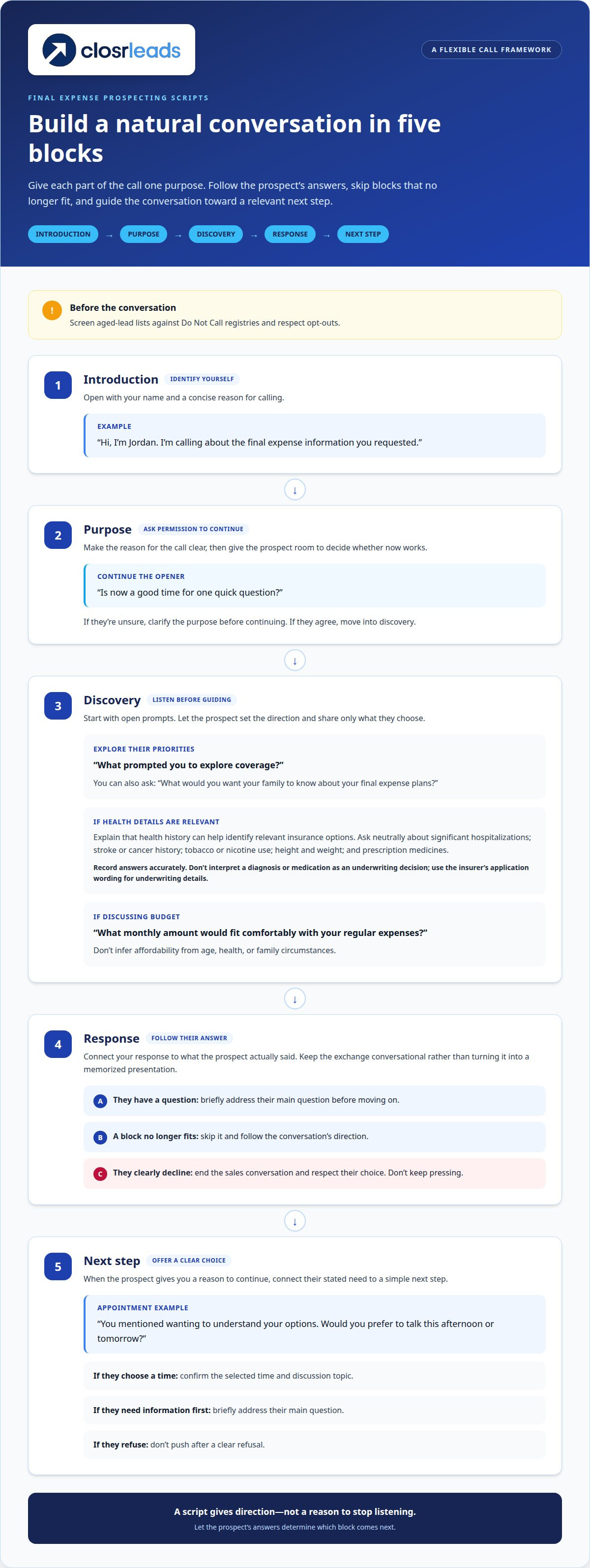
Organize your script into blocks: introduction, purpose, discovery, response, and next step. Treat final expense prospecting scripts as modular guides, with each block serving one purpose, such as explaining the call or clarifying the prospect’s priorities. Add short transitions, make sure each question follows naturally from the previous answer, and skip any block that no longer fits.
-
Adapt Blocks for Cold Calls
Open with your name and a concise reason for calling. For example: “Hi, I’m Jordan. I’m calling about the final expense information you requested. Is now a good time for one quick question?” If the person agrees, ask what they hoped to learn. If they’re unsure, clarify the purpose before continuing. Keep discovery flexible rather than turning the call into a memorized presentation.
-
Guide the Conversation to an Appointment
Move to scheduling once the prospect gives you a reason to continue. Try: “You mentioned wanting to understand your options. Would you prefer to talk this afternoon or tomorrow?” Offer clear choices, then confirm the selected time and discussion topic. If they need more information first, briefly address their main question. Use final expense prospecting scripts to make appointment transitions direct, without pushing after a clear refusal.
Curiosity-based openers
For warm leads, refer to the inquiry and ask what information the person hoped to receive. For referrals, say who suggested the conversation, then ask permission to continue.
- Connect the opener to the lead’s context. For a warm lead, try, “You asked about final expense coverage. What prompted you to look into it?” This links the call to the prospect’s action and invites a specific answer. For a referral, say, “Morgan suggested I reach out about planning for final expenses. Is this a convenient time?” Don’t imply a relationship or request the prospect never gave.
- Ask a question that opens a real conversation. Use prompts such as, “What would you most like your family to understand about your plans?” or, “What part of final expense coverage would you like clarified?” These questions give the prospect control over the topic. Avoid scripted curiosity that quickly turns into a pitch, such as asking a personal question without explaining why it matters.
- Use the answer to choose your next question. If the prospect says they’re concerned about family expenses, ask what they’ve already considered. If they want to understand policy options, ask what information would help them decide whether to continue. Reflect one detail back, then pause. That small step shows you heard the answer and keeps the conversation from sounding like an interview.
- Make warm referrals feel transparent. Name the person who referred them only when appropriate, and never suggest that the referral guarantees interest. Try, “Taylor thought this might be useful, but I’d like to hear what you want to discuss.” If the prospect isn’t ready, ask whether they’d prefer to end the call or continue another time. Respect a clear refusal.
- Keep the opener short, then listen. Practice each version aloud and remove extra claims or background. A focused opener earns its place by prompting a useful response, not by explaining every feature. To put these conversation openers to work, explore final expense lead options that can connect your script with interested prospects.
ClosrLeads: Final Expense Leads
ClosrLeads offers Final Expense Leads for agents ready to put a structured conversation plan into practice. Choose real-time or aged leads to suit your follow-up approach. Every fresh lead is OTP phone-verified and TCPA-compliant, and invalid contacts are credited or replaced under the replacement policy.
ClosrLeads delivers leads instantly to your CRM via webhook or CSV. The Built-In Dialer gives agents a practical way to move from a prepared opener to an organized call workflow. Veteran Insurance Leads and IUL Leads are also available for agents working across those categories.
When your script is ready, ClosrLeads can provide relevant lead flow to support your prospecting. Explore Final Expense Leads and choose real-time or aged leads to fit your approach.
Put Your Script Into Practice
A strong script is a working tool, not a fixed speech. Use it to give each call a clear path, then let the prospect’s answers shape the conversation. After calls, note which phrases prompted useful responses and where discussions stalled. Refine those moments while keeping your language direct, respectful, and recognizably yours.
Regular review helps your final expense prospecting scripts stay aligned with real conversations instead of becoming routine recitations. Keep the structure consistent, but adjust examples and transitions when prospects need a different explanation. Focus on progress through better listening and purposeful follow-up, not pressure.
When you’re ready to support that process with relevant leads, contact ClosrLeads to discuss your leads. Take the next step with a clear approach and keep building conversations that feel focused, useful, and human.
Frequently Asked Questions
Why Creating the Right Script is Necessary?
The right script gives each call direction without forcing a rigid pitch. It helps agents explain the call’s purpose, listen for the prospect’s priorities, and choose a relevant next step. For example, if someone wants information for a spouse, focus on that concern instead of reciting unrelated policy details. A useful script supports consistency while leaving room for genuine responses.
What opening lines work best when calling final expense insurance leads?
Opening lines work best when they identify the caller and give the prospect a reason to engage. For example: “Hi, this is Alex. I’m following up about your request for information. What would you like to understand first?” This clarifies the call’s context and gives the person an easy way to guide the discussion. Don’t imply a prior conversation if one didn’t happen.
What questions should agents ask to qualify final expense prospects?
Ask questions that clarify the prospect’s goals, existing plans, and preferred next step. For example: “Who would you want involved in this decision?” and “What would make a policy worth considering for you?” If the prospect raises a concern, ask what detail would help address it. Focus on their answers instead of treating every question as a checklist item.
How should agents handle common final expense objections, such as cost or already having coverage?
Acknowledge the objection, then ask permission to understand it before responding. If the prospect says cost is a concern, try: “What part of the expense feels hardest to fit into your plans?” If they already have coverage, ask whether they feel it addresses their current goals. Respond only to the concern they raise. If they decline further discussion, end respectfully.
What are examples of final expense insurance follow-up scripts and voicemail messages?
Keep follow-up brief and specific: “Hi, Pat. I’m following up on our conversation about your coverage questions. Is there a detail you’d like me to clarify?” A voicemail might say: “Hi, Pat, this is Alex calling about your request for final expense information. You can return my call if you’d like to continue the conversation.” Leave your name, purpose, and a clear next step without pressure.