Blog
How to Tell if an Insurance Lead Is Fake by Checking Forms
Learn how to tell if an insurance lead is fake by checking forms, verifying identity, and spotting suspicious life insurance offers before follow-up, with care.

A polished form can still point to a fake insurance lead. Knowing how to tell if an insurance lead is fake starts with checking for altered fields, spelling errors, inconsistent personal details, and offers tied to life insurance coverage that may not exist. One suspicious detail isn’t proof, but several mismatches deserve attention.
It’s reasonable to trust a form that looks official, but a convincing layout can hide incorrect information. Someone claiming to sell life insurance may also lack authorization to represent the insurer. Be especially cautious if they ask you to pay premiums directly to them.
This guide covers form details that may raise a red flag, how to assess suspicious life insurance offers, and practical ways to review a lead’s contact information and identity. Use a consistent process to distinguish questionable information from a lead ready for follow-up.
Key Takeaways
- Look for altered fields, inconsistent formatting, misspellings, and insurer-name variations that may warrant closer scrutiny.
- Use independently published insurer contact details to check whether a policy and named insured exist.
- Review the form and submission records for evidence of how the lead agreed to be contacted.
- Use a built-in dialer to organize follow-up with insurance leads once their details and contact permission have been assessed.
1. Spotting altered forms and spelling errors
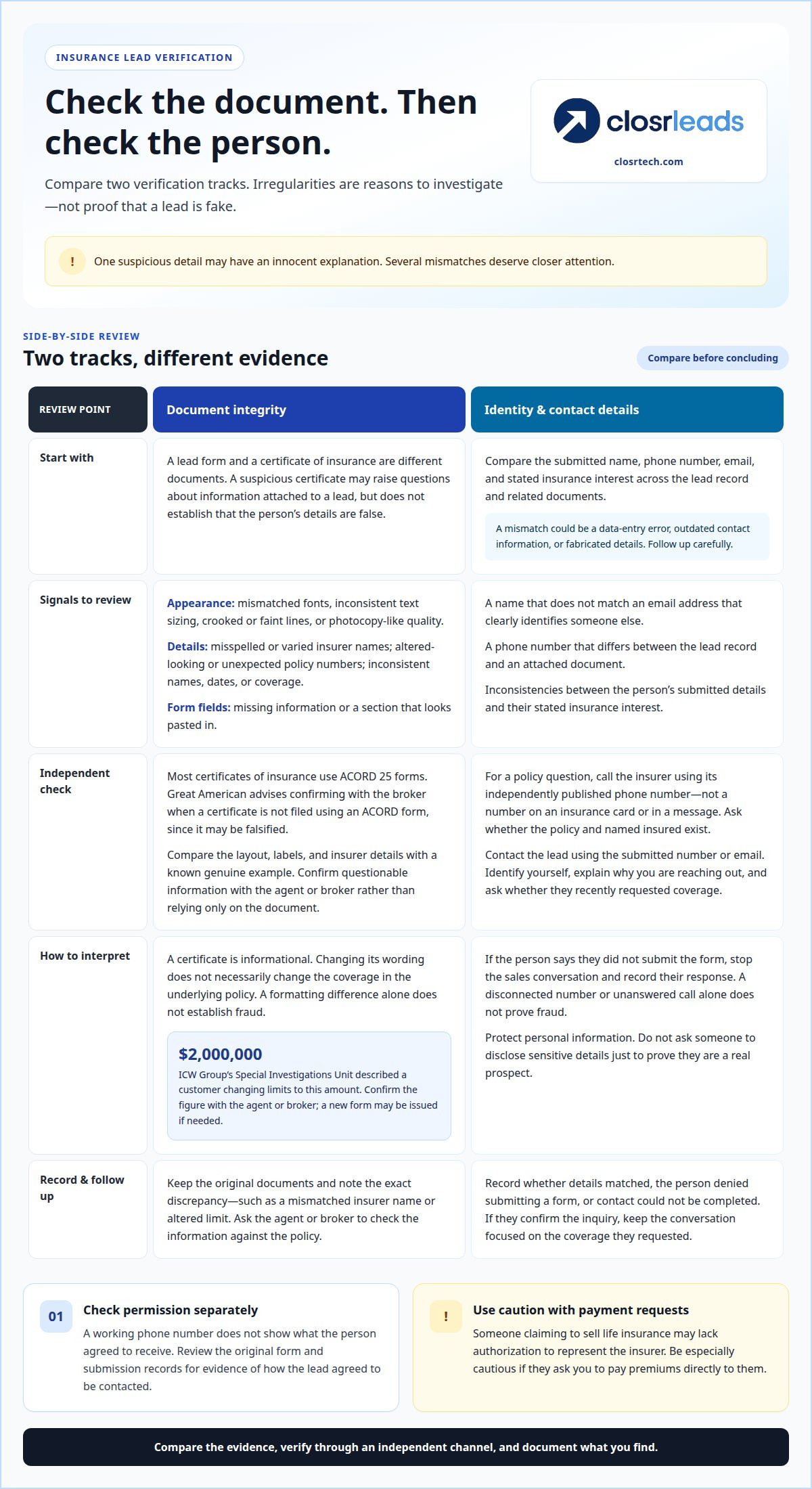
A lead form and a certificate of insurance are different documents. A suspicious certificate may raise questions about information attached to a lead, but it doesn’t prove the person’s details are false. Treat irregularities as signals to investigate, not a verdict. That distinction matters when deciding how to tell if an insurance lead is fake.
Start with the document’s structure. Most certificates of insurance use ACORD 25 forms. Great American advises confirming with the broker when a certificate isn’t filed using an ACORD form, since it may be falsified. Compare the layout, labels, and insurer details with a known genuine example from that insurer. Watch for mismatched fonts in key sections, identical text sizing throughout, crooked lines, faint printing, or photocopy-like quality.
Check each detail for consistency. Spelling errors or variations in an insurer’s name can signal a problem. A policy number that looks altered or doesn’t follow the expected format also deserves review. Compare names, dates, and coverage details across documents. A missing field or a section that looks pasted in can point to areas for closer review.
ICW Group’s Special Investigations Unit has encountered fabricated or falsified certificates in staffing, construction-related trades, and healthcare businesses. One example involved limits changed to $2,000,000 by a customer. That figure should be confirmed with the agent or broker, with a new form issued if needed. A certificate is informational; changing its wording doesn’t necessarily change the coverage in the underlying policy. For property owners seeking professional assistance with actual coverage terms and claim disputes, donnauro.com offers public-adjusting advocacy for residential and commercial property insurance claims.
- Look for visual edits: Compare fonts, spacing, lines, and print quality across the certificate.
- Check the insurer’s name: Note misspellings or small variations that could imitate a legitimate company.
- Review identifiers: Flag policy numbers or coverage details that appear altered or inconsistent.
- Validate through another channel: Confirm questionable information with the agent or broker, rather than relying only on the document.
Keep the original documents and note the exact discrepancy, such as a mismatched insurer name or altered limit. Ask the agent or broker to confirm the information against the policy. A polished form can still contain false details, but a formatting difference alone doesn’t establish fraud. Consider the overall pattern of inconsistencies before deciding whether a lead needs closer scrutiny.
Apply the same comparison to an insurance card: compare its printed format with known genuine examples from the insurer. Appearance is one clue, not a substitute for checking the information. On a Certificate of Insurance, a photocopy-like appearance, visible alteration, or mismatched fonts in key sections may be a warning sign of fraud.
Crooked or faint lines on a Certificate of Insurance may indicate tampering. Investigate a policy number that appears altered or doesn’t match the expected format. When high-value policies or complex document fraud are suspected, engaging a professional firm like International Investigative Group can help verify suspicious records. Use these clues to guide your document review.
3. How can agents verify an insurance lead's identity and contact information?
Start with the information the lead submitted. Compare the person’s name, phone number, email, and stated insurance interest across the lead record and any related documents. A mismatch could reflect a data-entry error, outdated contact details, or fabricated information. Follow up carefully rather than assuming the lead is fake.
For a lead connected to an existing policy, confirm details using the insurer’s published phone number. Don’t rely on a number printed on an insurance card or supplied in a message. Ask whether the policy and named insured exist, and keep the call focused on resolving the discrepancy.
Contact the lead using the number or email provided in the submission. Identify yourself and explain why you’re reaching out, then ask a simple question related to the request, such as whether they recently asked about coverage. If they say they didn’t submit the form, stop the sales conversation and record their response. A disconnected number or unanswered call alone doesn’t prove fraud.
Check for internal inconsistencies before reaching out. A form, for example, may list one person’s name but an email address that clearly identifies someone else. The phone number may also differ between the lead record and an attached document. Note each mismatch separately to help distinguish a typo from a pattern that needs further review.
- Match the records: Compare the submitted name and contact details across available records.
- Use an independent channel: For a policy question, call the insurer at its published number, not a number supplied on the card.
- Confirm the request: Ask whether the person submitted an inquiry, without pressuring them to continue.
- Document the result: Record whether the details matched, the person denied submitting a form, or contact could not be completed.
Protect personal information during every check. Don’t ask someone to disclose sensitive details just to prove they’re a real prospect. If they confirm the inquiry, keep the conversation focused on the coverage they requested. For example, follow up with a Veteran Insurance lead about that stated interest, rather than making assumptions based on the lead category alone.
Use the same review process for every lead. A genuine person may mistype an email address, while a polished record can still contain false details. Compare the submission, follow up through an appropriate channel, and record what the person confirms. This gives agents a practical way to distinguish verified contact information from unresolved details.
When verifying a policy, call the insurer’s published phone number to confirm that the policy and named insured exist. Don’t use the number printed on the card.
4. How to verify insurance lead contact consent?
A working phone number doesn’t show what the person agreed to receive. Review the lead’s original submission and keep its consent details with the contact record. A clear record helps distinguish an inquiry about coverage from a form submitted for another purpose.
Start with the exact form version shown when the person submitted their information. Check the wording beside the consent checkbox, whether they selected it, and which contact methods the form described. Permission to receive a phone call, for example, shouldn’t automatically count as permission for a text message. Keep the wording intact rather than relying on a summary such as “consented.”
Next, examine the submission record. Useful details include the date and time captured, the page or source that generated the lead, and the contact information entered. Match these details to the person and inquiry. If a vendor supplied the lead, retain the source record and the form language associated with that submission.
- Inspect the form: Review the actual consent language and the selected checkbox, if present.
- Match the scope: Compare the contact method used with the method described on the form.
- Trace the source: Record the originating page or lead source and submission details.
- Keep the record together: Store the form evidence with the lead’s contact and inquiry information.
Phone verification answers a different question. A one-time passcode can help show that someone had access to a phone number during verification. It doesn’t, by itself, show what they agreed to when submitting a form. Treat identity and consent as separate checks, and retain evidence for each.
Watch for changes after submission. If the lead record shows one phone number but the consent record names another, pause and resolve the mismatch before outreach. If the person says they didn’t submit the inquiry or asks not to be contacted, record their response and stop sales follow-up. A general consent label shouldn’t override what the person tells you.
Build a consistent review path: locate the original form, match its consent details to the lead, and document the outcome. This gives agents a clearer basis for deciding whether an inquiry is ready for contact. To support a more organized lead workflow, explore insurance lead options.
ClosrLeads
ClosrLeads provides insurance leads and tools for follow-up, including Final Expense, Veteran Insurance, and IUL Leads, plus a Built-In Dialer. Every fresh lead is OTP phone-verified, helping confirm access to the submitted phone number. Phone verification doesn’t replace reviewing the submission and its consent details.
Use these checks to assess each lead’s form information, identity, and consent before outreach. Then focus follow-up on the person’s stated insurance interest. Keeping review separate from the sales conversation helps agents organize leads for contact through the dialer.
For insurance leads and a streamlined follow-up workflow, contact ClosrLeads.
Build a Stronger Lead Review Process
Knowing how to tell if an insurance lead is fake gives your team a practical starting point. Make the assessment repeatable: define the information to review, how to record mismatches, and when a lead is ready for outreach. Consistency helps agents handle unclear records without guesswork or treating every small error as proof of fraud.
Keep the process useful on the sales floor. Make review notes clear, so the next person handling a lead can see what was checked and what remains unresolved. That clarity supports better decisions as your pipeline grows and helps you treat each person’s inquiry with care.
Ready to discuss insurance leads for your workflow? Contact ClosrLeads about your leads. Keep refining your review process, and give your team a clearer path from inquiry to informed follow-up.
Frequently Asked Questions
What are common signs that an insurance lead is fake or low quality?
To tell if an insurance lead is fake, distinguish fabricated information from a genuine prospect who may not be a good fit. A fake lead may use an identity that can’t be connected to a real person; a low-quality lead could be a real inquiry from someone with little interest in the coverage offered. Someone seeking a different type of policy, for example, may be a poor-fit lead, not a fake one.
How can agents spot duplicate, recycled, or resold insurance leads?
Compare the lead’s name and contact details across available records, and note mismatches separately. For vendor-supplied leads, retain the source and the form language associated with each submission.
What steps should agents take before buying leads from an insurance lead vendor?
Before buying, check whether the vendor provides the originating source, original form and consent wording, and submission details for each lead. Treat OTP phone verification as evidence of access to a phone number, not proof of consent; review consent separately.