Blog
How to Vet Insurance Lead Vendors: Quality, Terms and Trust
Learn how to vet insurance lead vendors by checking consent proof, lead quality, exclusivity, contract terms, and remedies before you commit to a source.

A twelve-month minimum contract is a reason to pause and review the terms, not to rush into a commitment. When learning how to vet insurance lead vendors, assess how leads are sourced, what evidence of consumer consent is documented, and what happens when a contact is invalid. Clear terms should explain lead quality, distribution, and remedies before you buy.
It’s reasonable to want predictable lead flow and a vendor you can trust. But a polished pitch won’t tell you whether contacts are genuinely interested, how many agents receive each lead, or whether the contract gives you room to respond to poor results. This guide shows you how to assess lead quality, contract terms, vendor transparency, exclusivity, and warning signs. You’ll get a sharper framework for comparing vendors, spotting avoidable risks, and choosing a lead source that fits your sales process. No guesswork. Just the questions that matter before you commit.
Key Takeaways
- Treat a twelve-month minimum commitment as a red flag, and understand the exit terms before you agree.
- Assess lead quality by asking how contacts were sourced and whether the vendor can provide verifiable proof of consumer consent.
- Clarify how leads are distributed, how many agents receive each one, and what remedies apply when a lead is poor.
- Watch for repeated reselling, unclear data safeguards, and requests for untraceable payment methods.
1. Are long contracts a red flag for lead vendors?
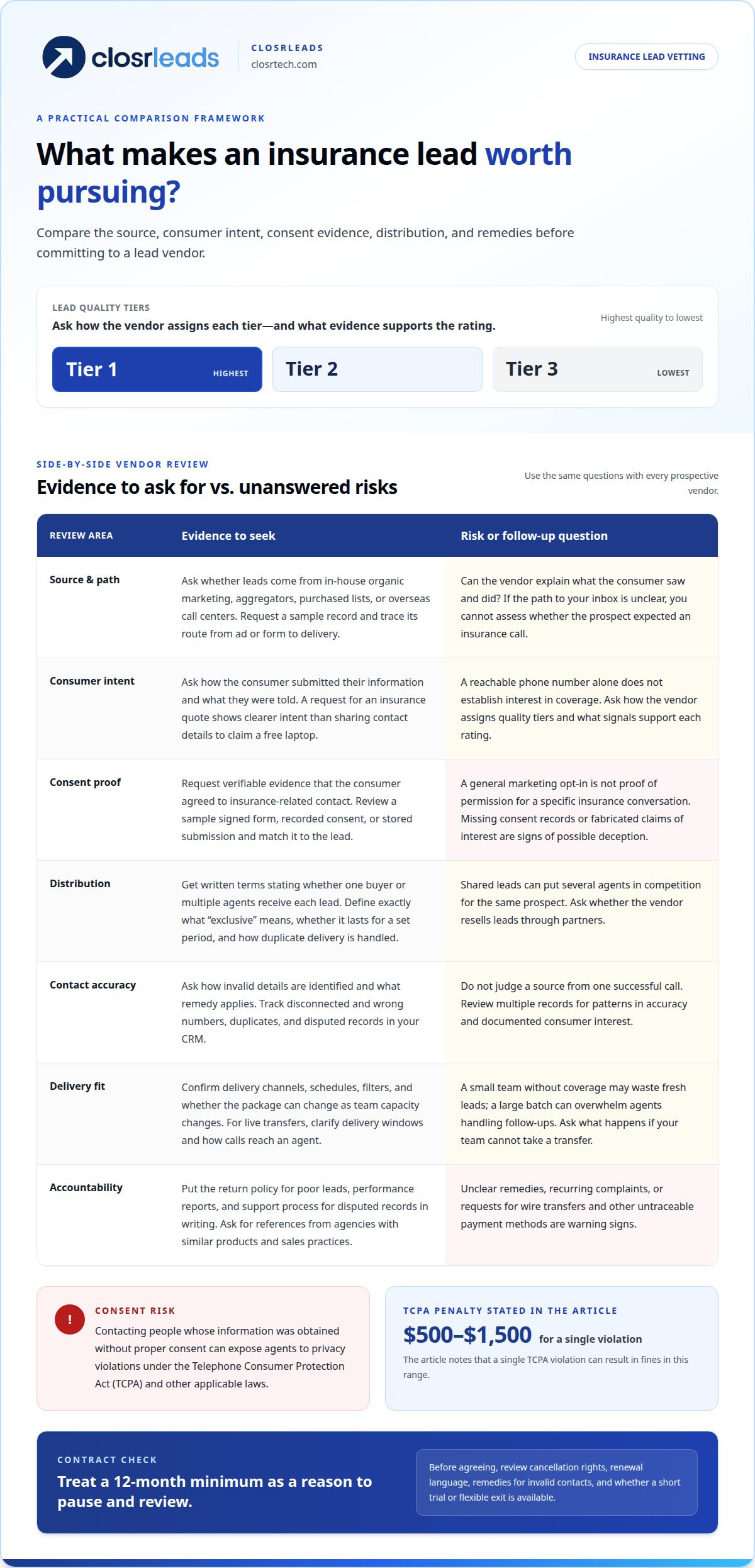
A twelve-month minimum can lock you into a vendor before you know whether its leads perform. Treat that term as a red flag, then review cancellation rights, renewal language, and remedies for invalid contacts. Ask what happens when you report a bad lead, and get the answer in the contract. A short trial or flexible exit reduces the risk of paying for a program your team cannot use.
Knowing how to vet insurance lead vendors starts with tracing the source. Ask whether leads come from in-house organic marketing, aggregators, purchased lists, or overseas call centers. Ask what consumers saw, what action they took, and how consent is recorded. If a vendor can’t explain the path from an ad or form to your inbox, you can’t assess whether the prospect expected an insurance call. Apply the same steps yourself when comparing options.
Fraudulent or noncompliant leads create more than wasted spend. Carriers hold agents responsible for validating that leads were obtained through compliant means. Agent-assisted health insurance enrollments tied to a noncompliant lead may trigger corrective action against the agent and upline. Fraudulent sourcing can also breach agreements with carriers, agencies, field marketing organizations, or supervisory committees, putting an agent’s appointment at risk. Separate poor conversion from signs of deception, such as fabricated claims of consumer interest or missing consent records.
For agents learning how to vet insurance lead vendors, matching delivery to team capacity is another essential step. A small team without coverage for incoming contacts may waste fresh leads, while a large batch can overwhelm agents handling follow-ups. Confirm delivery channels, schedules, filters, and whether the package can be revised as capacity changes. Compare those terms with your staffing plan before accepting a recurring commitment.
Clarify distribution in writing. Ask whether a lead is sold to one buyer or multiple agents, and what the vendor means by “exclusive.” Shared leads can put several agents in competition for the same prospect. Choose a delivery model that suits your team and make sure the vendor’s terms explain how leads are distributed.
2. How Is Lead Quality Determined?
Start with intent, not just a valid phone number. Insurance leads generally fall into three quality tiers, with Tier 1 the highest and Tier 3 the lowest. Ask how the vendor assigns each tier and what signals support that rating. A consumer who requests an insurance quote shows clearer intent than someone who shares contact details to claim a free laptop. The second contact may be reachable but less interested in coverage.
A practical way to vet insurance lead vendors is to compare the lead’s source with the consumer’s likely intent. Ask how the consumer submitted their information, what they were told, and how permission was recorded. Request an example of the consent record and compare it with the information attached to a lead. This helps you evaluate whether the consumer expected an insurance-related contact.
When deciding how to vet insurance lead vendors, assess consent records alongside lead quality. Ask for verifiable evidence that the consumer agreed to be contacted about insurance, then match it to the lead. A signed form, recorded consent, or stored submission can show what the consumer saw and agreed to. Don’t treat a general marketing opt-in as proof of permission for a specific insurance conversation. Contacting people whose information was obtained without proper consent can expose agents to privacy violations under the Telephone Consumer Protection Act (TCPA) and other applicable laws. A single TCPA violation can result in fines ranging from $500 to $1,500.
Ask how the vendor identifies invalid contact details and what remedy applies. Track disconnected and wrong numbers, duplicates, and other disputed records in your CRM. Review multiple records rather than judging quality from one successful call. Patterns in contact accuracy and documented consumer interest can help you decide whether a lead source fits your team.
3. Vendor transparency and lead exclusivity
Ask prospective vendors how they generate leads, where ads appear, and what consumers see before submitting information. Also ask how each lead is distributed, how many agents receive it, and what happens when a lead fails agreed quality standards. Clear answers let your agency compare vendors on actual practices, not sales claims.
Request a sample lead record and trace its route from ad to delivery. A vendor may use source IDs to track campaign performance while masking the specific origin. Ask what those IDs reveal, how they distinguish campaigns, and whether you can use them to compare conversion by source. If the vendor can’t explain its reporting, your team may struggle to identify which channels warrant more attention.
Define exclusivity in plain terms. Does “exclusive” mean one buyer receives the lead, or does it apply only for a set period? Ask whether the vendor resells leads through partners and how it handles duplicate delivery. Shared leads can create competition among agents. Exclusivity can reduce overlap, but only when the contract clearly defines distribution.
For live-transfer calls, clarify the scheduling process before launch. Ask which delivery windows are available, how calls reach an agent, and what happens if your team can’t take a transfer. Confirm how the vendor identifies the consumer’s request and passes relevant context. These details help you align transfers with staffing instead of leaving agents to guess.
Accountability matters after delivery. Get the return policy for poor leads, the performance reports you’ll receive, and the support process for disputed records. Review the vendor’s website, independent reviews, complaints, and social forums for recurring patterns. Ask for references from agencies with similar products and sales practices, then ask how their teams convert the leads. Treat requests for wire transfers or other untraceable payment methods as a warning sign. A transparent vendor should be able to explain its terms, tracking, and support without evasive answers.
4. Lead-vendor red flags
Watch for fabricated profiles, repeated resale, missing consent evidence, and weak data safeguards. A lead sold multiple times may put several agents in contact with the same prospect. Before accepting a batch, ask how the vendor detects duplicates, records consumer permission, and protects submitted information.
Review suspicious records individually. Compare names, phone numbers, timestamps, and source details in your CRM. If the same contact appears under different labels, flag the records and ask the vendor to explain the discrepancy. Repeated resale can mean several agents have already contacted the prospect, so confirm the vendor’s distribution terms before buying.
Check whether a lead record supports the claim that the person made an insurance inquiry. A mismatched name, disconnected number, or consumer who says they never requested contact may indicate inaccurate data or a more serious issue. Ask what evidence connects the record to the original submission and how the vendor investigates reports of invalid contacts.
Consent and security concerns are different from weak conversion. Review the permission evidence attached to each lead, and pause disputed contacts while you investigate. Ask how the vendor protects personal information, limits access, and responds to a suspected data breach. ClosrLeads uses access controls, encryption, and retention policies to protect data.
Separate a disappointing sales result from evidence of fraud. A low conversion rate alone doesn’t prove a vendor acted dishonestly; track outcomes by source, lead age, and agent follow-up. Look for patterns, such as repeated false details or leads created without a clear insurance-related request. A vetted process should document complaints, investigate them, and apply the remedy set out in the agreement.
Use a simple decision rule: stop delivery when records show repeated identity problems, unexplained resale, or missing consent documentation. Preserve examples and delivery details, then compare them with the vendor’s written response. Specific records give your agency a firmer basis for deciding whether to continue, dispute the leads, or end the relationship.
ClosrLeads: Final Expense Leads
ClosrLeads offers real-time and aged Final Expense Leads for agents building or expanding this line of business. Every lead is OTP phone-verified and TCPA-compliant, with documented consent records. Invalid contacts covered by ClosrLeads policy are eligible for a replacement or credit. These details give agents concrete criteria for comparing verification, consent documentation, and remedies.
Real-time leads are delivered to your CRM, and ClosrLeads offers a built-in dialer to work purchased leads. The dialer is available through paid plans. ClosrLeads also offers Veteran Final Expense, Trucker & CDL, Mortgage Protection, and IUL leads, so agents can select a vertical that matches their sales focus.
If you’re ready to assess whether these leads fit your process, contact ClosrLeads to discuss your needs.
Turn your vendor review into a stronger buying process
Make lead evaluation an ongoing process, not a one-time judgment. Record what your team expects from a lead source, then compare each vendor against the same standards as results come in. Revisit those criteria when your priorities change, such as shifting to another insurance line or adjusting how leads fit your follow-up workflow.
Use what you learned about how to vet insurance lead vendors to guide that review. ClosrLeads offers Final Expense Leads, Veteran Insurance Leads, and IUL Leads, giving agents options across these insurance lines. Choose the focus that aligns with your business, then assess the fit against your own team’s goals and follow-up process.
A clear next step can turn your evaluation into a practical conversation. Contact ClosrLeads to discuss your needs and explore which lead option fits your current priorities. Keep your standards clear, your decisions deliberate, and your team ready to make the most of each opportunity.
Frequently Asked Questions
Are long contracts a red flag for lead vendors?
Yes, a long minimum term deserves careful review, especially before you’ve evaluated the vendor’s leads. A twelve-month commitment can be risky if cancellation rights are narrow or renewal is automatic. Compare the minimum term with any trial period, termination notice, and remedy process. A written option to exit after a documented pilot, for example, offers more flexibility than a contract without an early exit.
How Is Lead Quality Determined?
Lead quality depends on whether the contact details are usable and the consumer showed relevant interest. Track outcomes by source, delivery age, and agent follow-up, then compare those patterns in your CRM. For example, separate leads that answer but decline coverage from invalid numbers or people who never requested an insurance conversation. Those categories reveal whether the issue is targeting, contact data, or sales process.
How can you verify an insurance lead vendor's licensing, reputation, and references?
Match the vendor’s legal business name across its contract and invoices, and review relevant public business records. Ask which licenses or registrations apply to its role, then validate claimed credentials with the appropriate authority. Look for recurring issues in independent complaints and feedback, not isolated comments. Ask references about delivery, dispute handling, and whether the vendor followed the written agreement when problems arose.
Are insurance leads exclusive, shared, real-time, or aged?
Lead distribution and timing vary, so confirm the definitions in the vendor’s terms. “Exclusive” generally means delivery to one buyer, while shared leads may go to multiple agents. Real-time leads arrive soon after a consumer inquiry; aged leads were collected earlier. Ask how delivery timing is recorded and whether leads may be resold.
What contract terms, minimums, refund policies, and replacement guarantees should agencies review?
Read the purchase minimum, billing trigger, renewal clause, cancellation notice, and lead-dispute deadline before approving an order. Then identify which defects qualify for a refund, credit, or replacement, and what evidence you must submit. For instance, a disconnected number may qualify under one policy, while a prospect who declines an offer may not. Make sure the written terms define each remedy clearly.
What TCPA, Do Not Call, CAN-SPAM, and state privacy rules apply to insurance leads?
Requirements depend on the contact method, consent record, and applicable jurisdiction. Review the rules for calls, texts, and email separately; document consumer permission and how your team handles opt-out requests. Include relevant state privacy requirements, and map each campaign’s process to the rules before outreach. A vendor’s general compliance statement does not replace your own review.