Blog
Insurance Lead Compliance 2026: TCPA, Records and Audits
Use the insurance lead compliance checklist 2026 to verify TCPA consent, retain records, vet providers, and build an audit trail that stands up to review.

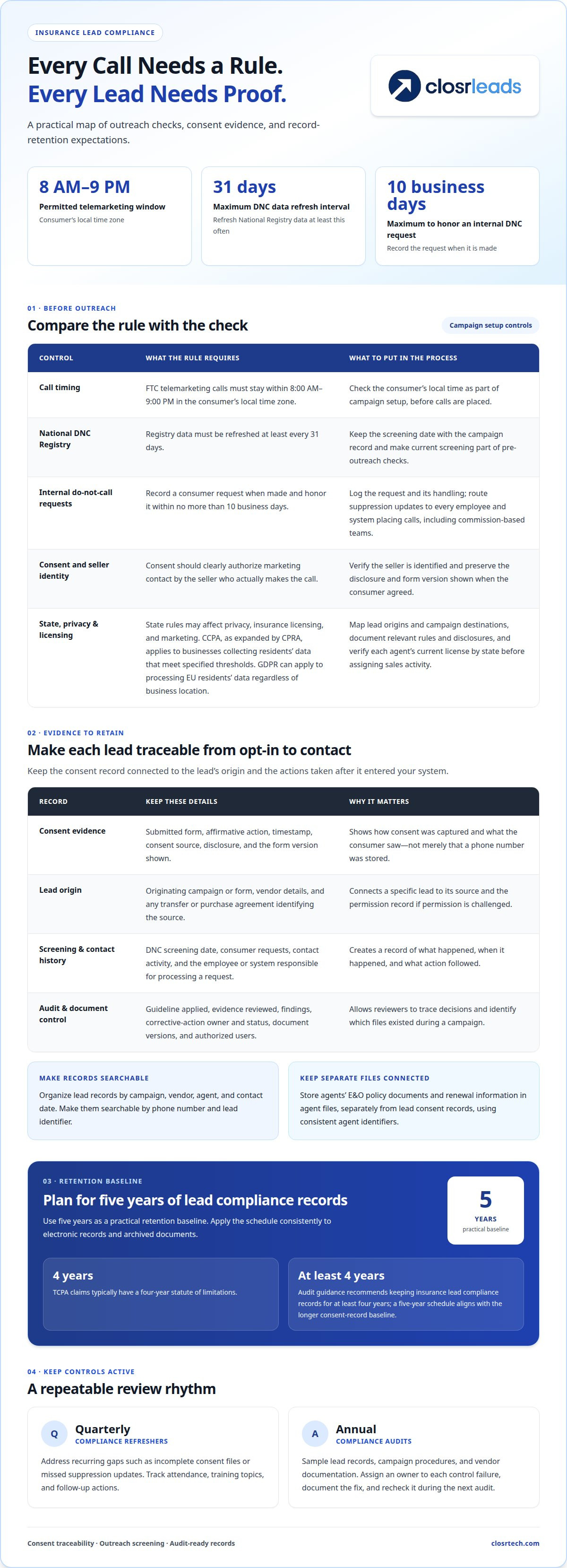
Lead compliance is won or lost before the first call. A practical insurance lead compliance checklist starts with checking consent and keeping records that document the consumer’s opt-in. According to the Federal Trade Commission, telemarketing calls are restricted to 8:00 AM through 9:00 PM in the consumer’s local time zone, and National Do-Not-Call Registry data must be refreshed at least every 31 days.
You already know consent matters. The challenge is proving the lead source captured consent for the seller who actually calls, then keeping that record intact as the lead moves into outreach. This guide shows how to assess lead-provider consent, apply key TCPA checks, and retain records that support an audit trail. Clear checks. Reliable documentation. A process your team can follow.
Key Takeaways
- Trace each lead back to its source and preserve evidence showing how consent was captured.
- Keep outreach and suppression records organized so your team can respond to do-not-call requests consistently.
- Build an audit trail that connects lead records, contact activity, and compliance reviews.
- Assess lead providers by the quality and traceability of their consent documentation, not just lead volume.
How Can Insurance Agents Stay TCPA Compliant in 2026?
The FTC’s Telemarketing Sales Rule covers businesses selling by phone, using prerecorded messages, or making outbound telemarketing calls. The Federal Trade Commission says telemarketing calls must stay between 8:00 AM and 9:00 PM in the consumer’s local time zone. It also requires callers to refresh National Do-Not-Call Registry data at least every 31 days. Build these checks into campaign setup, not just periodic reviews.
Keep federal and state screening requirements distinct. Before outreach, apply the current Do Not Call (DNC) list and maintain a process for recording each consumer’s internal do-not-call request. The Federal Communications Commission says callers must record a request when made and honor it within no more than ten business days. Ensure suppression updates reach every employee or system placing calls, including commission-based outreach teams.
State requirements can affect privacy, insurance licensing, and marketing practices. California’s CCPA, as expanded by CPRA, applies to businesses collecting residents’ data that meet specified thresholds. GDPR can also apply to businesses processing data from EU residents, regardless of where the business is located. Map where leads originate and where campaigns reach, then document the relevant privacy rules and disclosures.
Review license status on a recurring schedule. Requirements vary by state, so verify that agents hold current licenses and renew licenses or appointments as appropriate. Track each agent’s status by state before assigning sales activity. Keep jurisdiction-specific requirements separate in your records so a change in one state isn’t mistaken for a nationwide rule.
Employment-law updates also deserve a separate change log. Track state and local changes that affect employee notices, payroll, or commission workflows, then revise internal procedures where needed. For ACA reporting, employers must post a website notice or automatically provide employee statements by March 2, 2026. Employers must distribute Forms 1095-C for the 2026 calendar year by March 2, 2027. Record which employee groups and reporting steps each deadline affects.
How long do I need to keep lead compliance records?
Use five years as a practical retention baseline for lead compliance records. TCPA claims typically have a four-year statute of limitations, while compliance recommendations call for keeping records for at least five years. A consistent schedule helps preserve evidence if a complaint arises after outreach ends.
What consent language and disclosures must an insurance lead form include? The consent should clearly authorize the seller making the call. Identify that seller, explain that the consumer is agreeing to marketing contact, and preserve the disclosure and form version shown when consent was given. Keep the submitted form, timestamp, consent source, and lead origin together. An electronic record should show the consumer’s affirmative action, not merely a stored phone number.
For each lead, document its source and how it entered your system. Retain the originating campaign or form, consent record, and any transfer or purchase agreement identifying the source. If a consumer challenges permission, these records help connect the specific lead to the disclosure they saw. Make records searchable by phone number and lead identifier.
Keep agents’ errors and omissions policies in the relevant agent files. Record the policy document, covered agent, and renewal information so the agency can locate the evidence during a review. Store E&O documentation separately from lead consent records, using consistent agent identifiers to connect the files.
Maintain health-plan documents separately from lead records. Employers should update plan documents, including the Summary of Benefits and Coverage, to reflect new plan limits. For Form 5500, employers with 100 or more participants in self-insured or ERISA-covered plans are subject to the filing requirement described in the compliance guidance. Track the applicable plan year, filing materials, and document version in the retention schedule.
A consistent intake process makes lead origin easier to document. Explore insurance lead options as you organize records for each lead source.
Compliance audit trails and record retention
Build an audit trail showing what happened, when it happened, and what action followed. Organize lead records by campaign, vendor, agent, and contact date. Audit guidance recommends keeping insurance lead compliance records for at least four years. A five-year retention schedule can align these records with the longer consent-record baseline. Apply the schedule consistently to electronic records and archived documents.
- Connect each lead to its source. Keep the campaign identifier, vendor details, consent evidence, and contact history together so reviewers can trace the record.
- Log screening and suppression actions. Preserve the dnc list screening date, any consumer request, and the system or employee responsible for processing it.
- Record audit findings and owners. Note the applicable guideline, evidence reviewed, assigned corrective action, and completion status for each issue.
- Track versions and access. Record document changes and authorized users so an audit can identify which files existed during a campaign.
Use quarterly compliance refreshers to address recurring gaps, such as incomplete consent files or missed suppression updates. Track attendance, training topics, and follow-up actions. Pair refreshers with annual audits that sample lead records, campaign procedures, and vendor documentation. If a review identifies a control failure, assign an owner, document the fix, and recheck that control during the next audit.
Keep COBRA records distinct from lead files, but include them in the organization’s broader compliance calendar. COBRA continuation coverage applies to employers with 20 or more employees after qualifying events, including termination or reduced hours. The premium cap rate is 102 percent when calculating the next calendar year’s premiums. Document notice steps, qualifying-event records, premium calculations, and review dates to support an audit of the applicable plan period.
Close each audit with a dated action log. Identify the issue, affected records, responsible employee, corrective step, and evidence of completion. Retain the log with the audit findings and relevant vendor records. This connects regulatory review to operational change and prevents findings from being left without a documented resolution.
Lead-provider compliance checks
A lead’s compliance record starts with its source, not its arrival in your CRM. Assess the provider’s consent process before routing leads to agents. Consent from a lead aggregator alone is not sufficient; consent must be direct. Use an insurance lead compliance checklist 2026 to define what source, disclosure, and consent evidence must accompany every lead. Keep the originating form or campaign, submission time, consent language, and authorized seller tied to each record.
Use a provider review that tests evidence, handling, and handoffs:
- Review the actual consent flow. Match the form disclosure to the call or text the lead will receive, and confirm it identifies the seller.
- Trace a sample lead. Follow its source record, consent event, delivery, and CRM entry to find missing links.
- Test suppression handling. Confirm opt-out information travels with the lead and agents can act on it; a reply such as STOP can provide an easy opt-out mechanism.
- Document changes. Record updates to forms, campaigns, and lead-routing procedures so later reviews can identify which version applied.
Don’t treat phone verification as proof of marketing consent. Verification supports confidence in contact information, but the consent record must independently show what the consumer agreed to and where. Keep evidence of human engagement, such as the completed form and its timestamp. An insurance lead compliance checklist 2026 should flag records that contain only a purchased contact without a traceable origin.
Set a clear acceptance process for agents. Route a lead only when its source, consent evidence, and suppression status are available. Pause outreach if any of those details are missing, then document the resolution. This creates a consistent response to potential violations and makes provider performance easier to audit. Assess each campaign’s calling and texting methods against the applicable consent requirements.
For a more traceable intake workflow, review phone-verified lead options alongside your provider checks.
ClosrLeads
ClosrLeads provides insurance leads with documented consent and a streamlined path into outreach. Every lead is OTP phone-verified, and the capture is TCPA-compliant with consent records. Leads are delivered to your CRM via webhook or CSV the moment they come in. Review the records as part of your own consent and compliance process, including how your campaign handles screening and follow-up.
Choose from Final Expense, Veteran Insurance, or Index Universal Life Insurance leads based on your sales focus. The Built-In Dialer helps bring lead handling into one workflow. Keep your own consent evidence, suppression records, and audit trail alongside every lead. Provider documentation supports your process; it doesn’t replace the checks your agency must maintain.
If you’re ready to align lead sourcing with a more organized compliance workflow, contact ClosrLeads and integrate your insurance lead compliance checklist 2026 strategies today.
Make compliance part of your next growth step
Turn your insurance lead compliance checklist for 2026 into a working process, not a document that sits untouched. Build clear ownership for lead intake, campaign decisions, and record maintenance. Then make those responsibilities part of everyday operations, so agents know which controls apply before outreach begins.
Lead sourcing is one part of that process. ClosrLeads offers Final Expense Leads, Veteran Insurance Leads, and IUL Leads for agents building campaigns in those areas. Align the lead type with your sales focus, then apply your own consent, screening, and documentation procedures to each campaign. The aim is a steady workflow that supports responsible follow-up without adding needless friction.
Ready to discuss lead sourcing alongside your compliance process? Contact ClosrLeads to discuss lead compliance. Take the next step with a clear process and keep your team moving forward.
Frequently Asked Questions
Can I use a third-party lead generation platform and still be compliant?
Yes, using a platform doesn’t remove your responsibility for how leads are contacted. Define each party’s role in the service agreement, including who captures consent and how suppression requests move between systems. Before launching a campaign, test a sample record from intake through agent assignment. If consent details don’t arrive with the lead, hold that record until the gap is resolved.
What Happens If You Call a Lead Without Proper TCPA Consent?
A call without required consent can expose a business to TCPA claims and penalties. Reported statutory damages range from $500 to $1,500 per violation, depending on the violation. Each attempted contact should be traceable to its lead record, campaign, and calling method. If consent is disputed, stop further outreach while you review the evidence and prevent the number from re-entering active campaigns.
What is marketing compliance?
Marketing compliance means designing and running campaigns within the laws and rules that apply to each channel, audience, and location. For an insurance campaign, that can include consent, do-not-call screening, truthful disclosures, privacy practices, and licensed sales activity. For example, review a lead form, its consent language, the resulting contact method, and the records agents need before outreach.
What is the One-to-One Consent Rule for insurance leads?
The phrase describes a seller-specific consent approach: a consumer’s permission should identify the business authorized to contact them—such as a specific provider like Verdant Insurance—rather than treating one broad form submission as permission for unrelated sellers. For insurance leads, keep the named seller and consent evidence attached to each record. Don’t assume that purchasing or transferring a lead alone proves the consumer agreed to contact from your agency.
What should I do if a consumer disputes consent?
Pause calls and texts to the consumer while you review the dispute. Preserve the lead record, form version, consent event, campaign details, and contact history. Check whether the record identifies your business and the relevant permission. Record the review outcome and suppress the number if the consumer asks not to be contacted. Keep the complaint and resulting action together for future review.
What federal laws govern insurance lead generation and sales in 2026?
Key federal rules include the Telephone Consumer Protection Act for calls and texts, and the Telemarketing Sales Rule for covered phone sales and outbound telemarketing. CAN-SPAM governs commercial email, while HIPAA may apply when protected health information is involved. These rules don’t replace state insurance licensing or privacy requirements. Match each campaign’s channel and data use to the rules that apply.