Blog
IUL Prospecting Scripts for High Net Worth Retirement Planning
Use IUL prospecting scripts for high net worth clients to qualify fit, explain trade-offs, and discuss potential retirement income without overpromising.

Strong IUL conversations begin with fit, not a pitch. IUL prospecting scripts for high net worth clients should help uncover whether someone has a protection need, room in their financial plan for premiums, and interest in another potential source of tax-advantaged retirement income.
That takes more than a polished opener. High-income prospects need a clear explanation of indexed universal life: policy cash value may earn interest based in part on an external index, but it is not directly invested in that index. Set realistic expectations about policy costs, access to cash value, and the trade-offs involved.
Use the scripts and structure in this guide to identify promising prospects, begin discovery conversations, and explain IUL without overpromising. You’ll also learn to position potential retirement income within a broader financial strategy, address common questions, and keep the discussion focused on the prospect’s goals. The result is a more disciplined conversation, from first contact to a thoughtful next step.
Key Takeaways
- Qualify prospects by exploring their protection needs, premium capacity, and retirement goals before explaining policy features.
- Describe index-linked crediting and cash-value access in plain language, while setting realistic expectations about costs and trade-offs.
- Frame potential retirement income as one part of a broader financial strategy, not a replacement for existing investments.
- Use a discovery-first conversation, then present a tailored illustration and agree on a clear next step.
1. Plain-language IUL explanation scripts and analogies
Explain what the policy does before discussing a projected return. “Indexed universal life is life insurance with a death benefit and cash value. Interest credited to the cash value is linked to an external index, but your money isn’t directly invested in that index.” An index can guide interest crediting without turning the policy into an index fund.
Then explain the moving parts. IUL policies can offer flexible premiums, adjustable death benefits, and access to cash value through loans or withdrawals. Cash value growth is tax-deferred. A policy may have a floor, often described as 0%, that limits index-related crediting when the index falls. Caps and participation rates can also limit credited interest, so agents should explain the specific policy terms rather than imply unlimited market gains.
Use a simple analogy, then explain its limits. “Think of the index as a measuring stick, not an account holding stocks. It helps determine interest credited under the policy’s rules.” Then ask: “Would you like to see how the policy’s death benefit and cash value could fit your protection and wealth goals?” This qualifies prospects based on their needs, not assumptions.
For affluent clients, distinguish IUL from term life, whole life, and investing. Term life provides coverage for a defined period; whole life has a different policy structure. IUL links cash-value crediting to an external index, while investing puts assets directly into chosen investments. IUL cash value is not directly invested in its linked index.
In the United States, agents must follow applicable state insurance licensing and marketing rules. Several states have adopted the NAIC Insurance Consumer Best Interest Model Regulation, which requires acting in the consumer’s best interest. Use carrier-approved language, document conversations, and disclose policy costs, fees, surrender periods, underwriting, caps, floors, participation rates, and index credits.
Be direct about limitations. Loans and withdrawals reduce available cash value and the death benefit, and can cause a policy to lapse or trigger taxable events. Surrender charges and periods affect access to policy value, so explain those terms before discussing a retirement-income illustration.
2. Positioning IUL for tax-advantaged retirement income
Position indexed universal life as a possible tax-diversification tool, not a replacement for qualified accounts or market investments. A prospect with substantial assets in a 401(k) or IRA could explore whether a life insurance policy adds another potential source of retirement income. Keep the focus on their tax profile, existing coverage, liquidity needs, and diversification preferences, rather than leading with an illustrated rate.
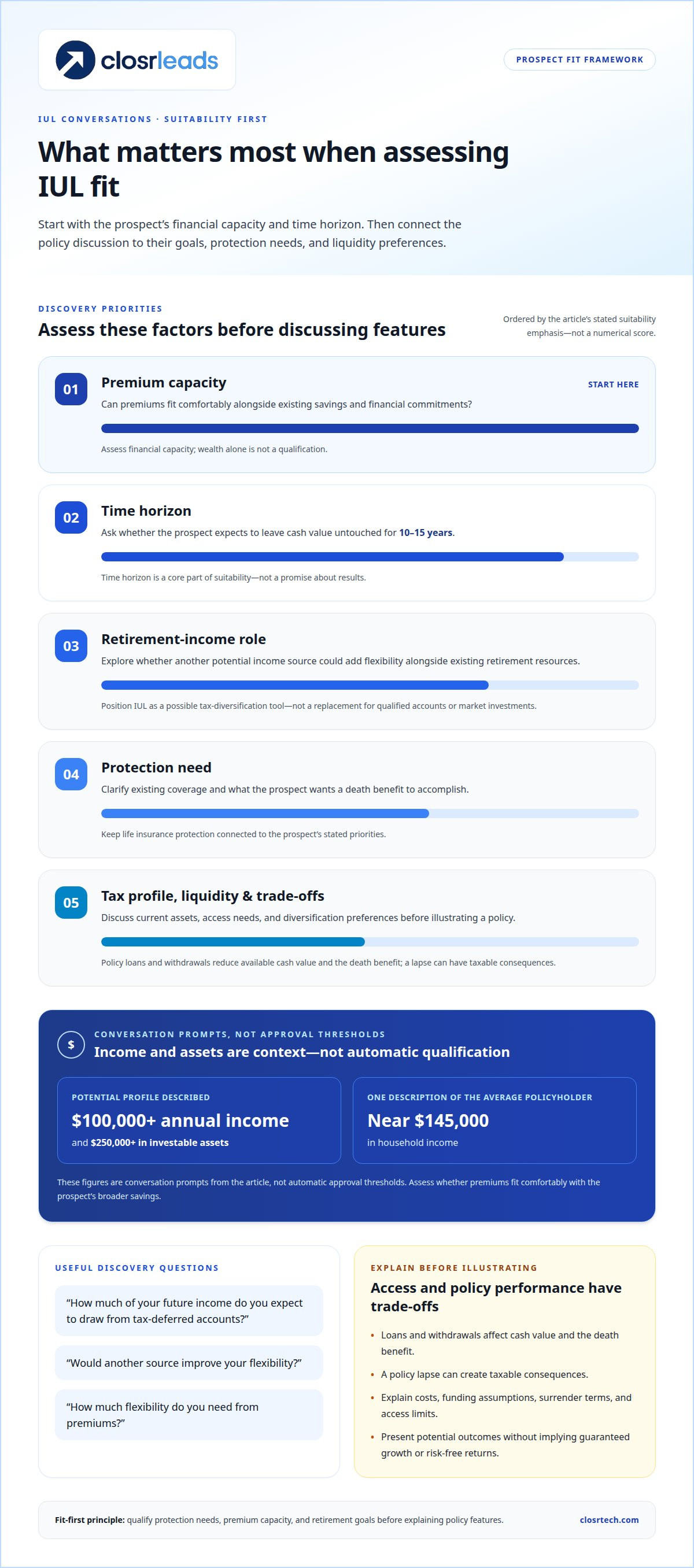
Suitability starts with both financial capacity and time horizon. A potential profile includes annual income of $100,000 or more and investable assets of $250,000 or more; one description of the average IUL policyholder puts household income near $145,000. These figures are conversation prompts, not automatic approval thresholds. Ask whether premiums fit comfortably alongside existing savings, and whether the prospect expects to leave cash value untouched for 10-15 years.
Explain the potential retirement-income mechanism without promising a result. Properly structured policy loans may provide income without income tax, but policy design and ongoing performance matter. Loans reduce available cash value and the death benefit; a lapse can create taxable consequences. Present access as a potential option, then explain how withdrawals, loans, and continued funding may affect the policy over time.
A useful discovery prompt is: “How much of your future income do you expect to draw from tax-deferred accounts, and would another source improve your flexibility?” Follow with questions about retirement timing, current assets, premium capacity, and the role of life insurance protection. Selling begins with that fit assessment, not a claim that IUL is suitable for every affluent household. Agents building broader insurance conversations can also explore insurance lead options for veteran and trucking audiences.
3. High-converting IUL script structure
Use two meetings to separate discovery from the policy presentation. In the first conversation, ask permission to understand the prospect’s priorities before discussing universal life insurance. Try: “What role should life insurance play in your protection or retirement strategy?” Listen for a specific need, existing coverage, premium capacity, and concerns about downside. Clarifying the problem first gives the second meeting a clear purpose.
Make discovery questions specific. Ask, “How do you expect to fund retirement income?” and “What would you want a death benefit to accomplish?” Then ask, “How much flexibility do you need from premiums?” These questions help assess fit without treating wealth alone as qualification. Reflect the prospect’s answer: “You want another potential source of income, but protecting family remains central. Have I understood that correctly?”
In the second meeting, connect the prospect’s priorities to policy mechanics. Explain interest crediting, then use a real, compliant illustration to show assumptions and possible outcomes. Present conservative, moderate, and optimistic scenarios, not just the strongest projection. Point out policy costs, funding assumptions, and how changes can affect performance. Avoid suggesting growth is guaranteed or returns are risk-free. The prospect should understand both potential value and downside.
Close with a decision-focused question, not pressure: “Which part of this illustration needs more explanation before you decide whether to continue?” Invite questions about the death benefit, cash value, policy charges, and access to funds. If the prospect needs more time, ask permission to follow up in 30 days. Record each conversation and agreed next step. This structure gives the prospect space to assess the proposal while keeping the process clear. It also gives agents a practical way to distinguish genuine interest from polite agreement, then adapt the next conversation to the prospect’s unanswered questions.
4. Introducing IUL in HNW Discovery Meetings
Begin a high-net-worth discovery meeting with the client’s priorities, not an IUL pitch. Ask, “Which financial goals need attention beyond your current investment and insurance strategy?” Listen for concerns about market volatility, family protection, or future income. Then ask permission to explore whether indexed universal life could fit. This frames the discussion as a possible planning conversation, not a product recommendation.
Clarify the need before describing policy mechanics. For a business owner, ask how a change in ownership could affect family security or succession plans. For an executive, explore how existing retirement accounts fit their preferred income mix. These questions can reveal whether protection or tax diversification merits further discussion. They also distinguish a genuine planning need from curiosity about index-linked growth.
Present IUL as a potential volatility-management tool, not a market alternative. Explain that cash-value interest is credited based on an external index, while the policy is not directly invested in it. Then use a real, compliant illustration to connect the prospect’s goals with policy assumptions. Highlight the illustrated scenario, charges, and possible effects of funding changes. Don’t lead with only the most favorable projection.
Keep the meeting interactive. After each explanation, pause and ask, “Which assumption would you like to examine more closely?” If the prospect focuses on access to cash value, explain how loans or withdrawals affect policy value and the death benefit. If family protection is the priority, return to the coverage need. Let each answer guide what you explain next.
End with a clear next step. Summarize the prospect’s stated goals, the questions still open, and any information needed for a tailored illustration. Ask whether they want to review that illustration in a separate meeting. A focused process keeps discovery distinct from presentation and gives the prospect time to assess trade-offs. To strengthen your prospecting workflow, keep each conversation organized around fit, clarity, and a specific follow-up.
ClosrLeads
ClosrLeads helps insurance agents put prospecting conversations into motion with IUL Leads and a Built-In Dialer. Use these tools when your discovery process is ready and you want to focus on reaching prospects, identifying their needs, and following up consistently. Leads are delivered into users’ CRM systems, supporting a practical handoff from delivery to outreach.
For a broader insurance pipeline, ClosrLeads also offers Final Expense Leads and Veteran Insurance Leads. Apply the same disciplined approach to each conversation: establish fit, ask about the prospect’s priorities, and explain relevant policy details without promising an outcome. A lead starts the discovery process; it does not replace suitability assessment or clear communication.
Contact ClosrLeads to discuss lead options that fit your prospecting workflow.
Put Your Next Prospecting Conversation in Motion
Turn a sound conversation plan into consistent outreach. Build IUL prospecting scripts for high net worth clients around their goals, then use each response to guide your next question. Focus on a clear, relevant discussion rather than a polished pitch. This discipline gives you a prospecting process to refine with experience.
ClosrLeads offers IUL Leads, Final Expense Leads, and Veteran Insurance Leads to support insurance prospecting across these audiences. Choose the lead type that fits your outreach focus, then bring your discovery approach to each conversation. Contact ClosrLeads to discuss lead options for your workflow. Start with a focused plan, keep the conversation centered on the prospect, and take the next step with confidence.
Frequently Asked Questions
How can advisors identify IUL leads?
To identify potential IUL leads, look for a clear protection or planning need and the capacity to sustain premiums. In an initial conversation, explore income stability, existing assets, current coverage, tax profile, and comfort with long-term funding. Interest alone may not indicate a suitable financial fit. Use these factors to decide whether a deeper review makes sense.
What are effective IUL prospecting scripts for affluent prospects?
Effective IUL prospecting scripts for high net worth prospects begin with a relevant planning question, not a product claim. Try: “Has your current financial strategy left any protection or retirement-planning goals unaddressed?” If the prospect identifies a gap, ask permission to explore whether permanent life insurance merits consideration. Keep the first conversation focused on their priorities, then agree on a clear next step.
What questions identify estate planning, liquidity, and legacy needs for IUL prospects?
Ask questions that reveal priorities without assuming IUL is the answer. For estate planning, try, “What responsibilities or assets would you want your plan to protect?” For liquidity, ask, “When might you need access to funds, and what sources would you use first?” For legacy, ask, “What would you want beneficiaries to receive?” The answers clarify needs and guide the next discussion.
What are compliant follow-up scripts for IUL prospects who want to review an illustration?
Use carrier-approved language, refer to the illustration’s actual assumptions, and record each follow-up. For example: “You wanted time to review the illustration. Which assumptions or policy details would you like to discuss?” Don’t present illustrated values as guaranteed outcomes. If the prospect needs more time, ask permission to reconnect and agree on a suitable date. Record the questions raised and the next step.