Blog
Problems with Shared Insurance Leads: Quality and Competition
Learn how problems with shared insurance leads stem from competition, timing, and consumer intent. Assess quality and choose leads that fit your sales process.

Shared insurance leads put several agents in front of the same prospect. The problems with shared insurance leads usually involve competition, timing, and consumer intent, not simply whether a record was sold more than once. Quality also depends on how the prospect’s information was collected.
Shared leads can add prospects to a pipeline, but they may also put more calls in competition for the same person’s attention. That trade-off matters when you weigh lead quality against response speed, cost efficiency, and the chance to start a useful conversation.
This comparison explains how shared leads differ from inbound calls, what to look for in replacement policies, and how response time can affect follow-up. It also covers how to assess competition and intent, with a practical guide to choosing leads that fit your sales process.
Key Takeaways
- Judge lead quality by how the prospect was generated, not just by whether the record is shared or exclusive.
- Factor agent competition into your follow-up plan, since several agents may pursue the same prospect.
- Look for signs of consumer intent to gauge whether someone is ready to discuss coverage or is still comparing options.
- Track response speed and replacement terms alongside conversion results to see which lead sources support your sales process.
Evaluating lead quality and replacement policies
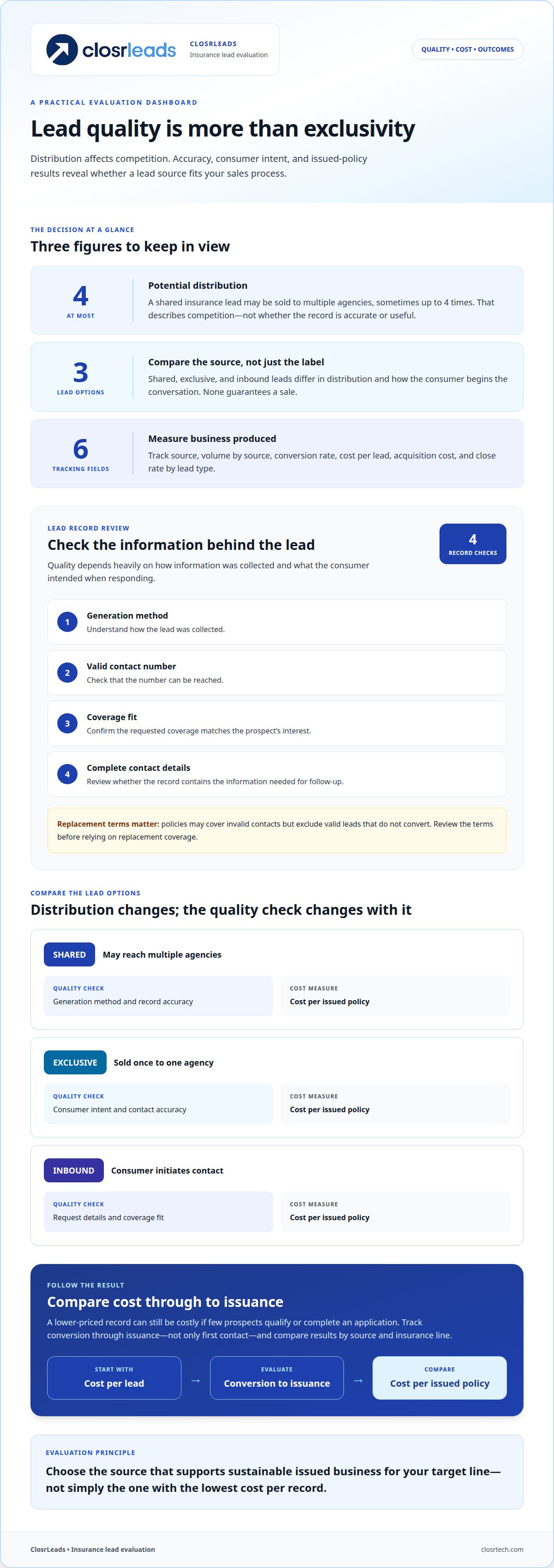
A shared insurance lead may be sold to multiple agencies, sometimes up to 4 times. That distribution affects competition, but it doesn't tell you whether the record is accurate or useful. Quality depends heavily on how lead generation collected the information and what the consumer intended when responding.
Start by reviewing the lead record. Confirm that the number is valid, the requested coverage matches the prospect’s interest, and the contact details are complete. Then distinguish incorrect information from a prospect who simply doesn’t buy. Replacement policies may cover invalid contacts but exclude valid leads that don’t convert, so understand the terms before relying on them.
Yes, lead quality and pricing can differ by state and insurance line. Local demand, competition, audience, and collection methods all shape the lead pool. A Veteran Insurance Lead and a Trucker Insurance Lead may reflect different consumer needs, so evaluate each line and target market separately.
Compare cost per lead with cost per issued policy. A lower-priced record can still be costly if few prospects qualify or complete an application. Track conversion through issuance, not just first contact, and compare results by source and insurance line. Overall averages can conceal a weak-performing segment.
Use a consistent tracking routine: record each lead’s source, volume by source, conversion rate, cost per lead, acquisition cost, and close rate by lead type. This helps show which sources produce issued business, not just activity.
| Lead option | Distribution | Quality check | Cost measure |
|---|---|---|---|
| Shared | May reach multiple agencies | Generation method and record accuracy | Cost per issued policy |
| Exclusive | Sold once to one agency | Intent and contact accuracy | Cost per issued policy |
| Inbound | Consumer initiates contact | Request details and coverage fit | Cost per issued policy |
Choose the lead source that supports sustainable issued business for your target line, not simply the one with the lowest cost per record.
Competition among agents for shared leads
Online shopping can turn one insurance inquiry into a race between agencies. Comparison websites may distribute a shared lead to several buyers, so agents can contact the same consumer close together. Someone expecting email quotes may instead receive calls from multiple sellers. That first interaction can determine whether the outreach feels helpful or intrusive.
Distribution varies by vendor and campaign. Shared insurance leads are commonly sold between 2 and 6 times, and some are resold to three to eight competing agencies. Shared health leads may reach dozens of agents. These patterns create direct competition, even when each agency represents a different carrier or explains coverage differently.
The challenge is practical: a consumer who has already spoken with several agents may be tired of repeating their needs, while someone still shopping may welcome a clear comparison. Treating both the same can waste the opportunity. Acknowledge the inquiry, ask what information they still need, and don’t assume they’re ready to apply.
- Respond with context: Mention the coverage request or comparison the consumer initiated. A specific opening sounds more relevant than a generic sales pitch.
- Lead with a useful distinction: Explain how policy options or carrier differences relate to the prospect’s stated needs. Keep the comparison focused.
- Respect the prospect’s pace: If they’re still shopping, ask whether they prefer a brief explanation or a scheduled follow-up.
- Track the outcome: Record contact timing, conversations, and close rates by lead source. This shows whether competition is affecting results.
Exclusive leads limit parallel competition because the opportunity goes to one agency; shared leads put several agents in contention. Neither label guarantees a sale. The better fit depends on your team’s follow-up capacity, the consumer’s intent, and whether your conversation offers value beyond another quote. Review results by source and adjust outreach if repeated calls create frustration instead of conversations.
How inbound and shared leads differ in consumer intent
A shared lead often starts when a consumer submits information to compare insurance options. That signals interest, but not necessarily a preference for a particular agency or carrier. The lead model matters: comparison-site traffic can prompt several follow-up calls, while a consumer-initiated inbound call connects the prospect directly with an agency. The first conversation may begin at a different point in the decision process.
Expectations shape the conversation. A person requesting quotes by email or text may feel frustrated after receiving 2 or 3 calls. Another consumer may want to discuss coverage immediately. Start by confirming what they requested and how they prefer to communicate. This helps agents match their approach to the person’s intent instead of treating every record as a ready-to-buy prospect.
For shared leads, TCPA and Do Not Call compliance depends on the actual consent disclosure and intended outreach. Other consent, do-not-call, and state requirements also apply. Review what the consumer agreed to and whether the planned call or message matches that permission.
Consumer-initiated inbound calls can indicate stronger intent because the person reaches out to discuss insurance. Exclusive, high-intent inbound health insurance calls may close at rates multiple times higher than shared leads. That comparison doesn’t mean every inbound caller is ready to enroll. Ask what prompted the call, what coverage they’re considering, and whether they’re comparing offers before suggesting a next step.
Volume alone doesn’t reveal intent. A shared campaign may deliver more records, while inbound calls create direct conversations. Track each model separately: note the source, requested contact method, whether you connect, and the outcome. If comparison-site prospects often request written information, tailor follow-up to that preference. If inbound callers ask about a specific coverage need, address it first. This shows whether a source creates useful conversations, not just a larger queue.
Contact rates and response speed
Shared leads can reach agents days or weeks after a prospect submits information. By then, the consumer may have received other calls or continued shopping. Vendors may deliver the same record at different times, so reaching out promptly matters. Agencies that aren’t first or second to dial typically lose the conversation. A late call can make a valid insurance inquiry feel irrelevant.
Exclusive inbound calls work differently: the prospect connects with an agent in real time, removing the delay between inquiry and conversation. These calls are described as having zero lead decay, though agents still need to respond promptly. Consumers may continue searching online if their immediate questions go unanswered.
Build a repeatable follow-up sequence for each lead type:
- Call new online leads immediately. Confirm the information by email and set a clear follow-up time.
- Use the first conversation to understand timing. Ask what coverage the prospect wants and whether they’re comparing options.
- Schedule the next touchpoint. If a direct-connect call doesn’t close, follow up within a day or two.
- Record each attempt. Track contact time, successful connections, next steps, and eventual close rate by source.
Most insurance leads need multiple touchpoints before converting. A consumer may close 7-10 days after the first contact while comparing offers. A reliable schedule keeps the conversation active without relying on repeated, unplanned calls. For example, after a warm transfer that doesn’t close, send a recap email and agree on a follow-up. That gives the prospect a useful reference and gives the agent a defined next step.
Measure contact rate and close rate separately. If one partner or vendor delivers records that rarely connect, compare delivery timing and source results before increasing volume. Streamline lead follow-up with a built-in dialer and keep new prospects moving through a consistent contact process.
ClosrLeads
ClosrLeads gives agents a practical way to add insurance prospects and support prompt follow-up. Its real-time and aged leads cover Final Expense, Veteran, IUL, Trucker, and Mortgage Protection insurance. Leads are OTP phone-verified, and invalid contacts are covered by a replacement guarantee.
Leads are delivered the moment they come in to the buyer’s CRM via webhook or CSV. ClosrLeads also provides a built-in dialer to help teams work their leads and keep follow-up organized. Results still depend on consumer intent, contact timing, and the agent’s approach.
Review ClosrLeads’ lead options and built-in dialer to find a fit for your pipeline and follow-up process.
Build a lead strategy you can refine
Make your lead process a system you can improve. Track which sources lead to useful conversations, then adjust follow-up based on how prospects respond. Measures such as qualified conversations and issued policies keep decisions grounded in outcomes rather than activity alone.
A stronger approach to problems with shared insurance leads starts with matching lead sources to your sales capacity and the coverage you serve. ClosrLeads offers Final Expense Leads, Veteran Insurance Leads, and IUL Leads for agents building their pipeline in those areas. Choose a next step that fits your team’s workflow, then keep measuring what happens after each new inquiry.
Contact ClosrLeads to discuss your leads and take the next step toward a more focused pipeline. Keep testing, learning, and sharpening your process.
Frequently Asked Questions
What are the most common problems with shared insurance leads?
Common challenges include competing calls, inaccurate contact details, unclear consumer expectations, and difficulty distinguishing an invalid record from a prospect who isn’t ready. A working number, for example, may reach someone who requested email information. Track contact outcomes and lead sources separately, and apply replacement terms to disconnected, wrong-number or invalid contacts, rather than treating every non-sale as a bad lead.
How many agents typically receive the same shared insurance lead?
There’s no single distribution count. Shared insurance leads are commonly sold between 2 and 6 times, while some campaigns may reach three to eight agencies. Distribution depends on the lead source and its sale terms. The practical impact is the number of agents contacting the same consumer, so interpret the stated distribution alongside your team’s capacity to follow up.
How does lead response time affect conversion rates for shared insurance leads?
Delay gives prospects more time to speak with other agents or lose interest. If a call goes unanswered, follow a planned next step instead of making repeated calls without context. Leave a concise message, send a relevant follow-up, and record the next attempt in your CRM. Compare connection and close rates by response timing to see where your process loses momentum.
What factors determine the quality of a shared insurance lead?
Quality depends on more than whether a record is shared. Consider how the consumer’s information was collected, whether the contact details work, how closely the request matches the coverage discussed, and how recently the person showed interest. A request for a specific policy conversation differs from a broad quote inquiry. Measure qualified conversations and issued policies by source to see which records fit your process.
How can insurance agents reduce duplicate calls and competition when working shared leads?
You can’t control how many agencies receive a shared record, but you can coordinate your own outreach. Assign one owner in the CRM, log each attempt, and set a next action before another agent on your team calls. Refer to the consumer’s request, then ask about their preferred contact method and where they are in the shopping process. This reduces internal duplication and makes each conversation more relevant.
What questions should agents ask lead vendors before buying shared insurance leads?
Ask how the prospect’s information was collected, how many buyers may receive each record, and how quickly leads are delivered. Clarify what counts as an invalid contact, which issues qualify for replacement, and how to submit a claim under the policy. Also ask what consent information accompanies the lead and whether the campaign targets your insurance line and intended audience.