Blog
Selling Final Expense to Veterans: Honest Cost Talks
Learn how to sell final expense to veterans with honest cost talks, clear VA benefit comparisons, and practical guidance on coverage and underwriting.

VA burial benefits aren’t the whole plan. Veterans can use final expense insurance to help cover funeral and burial expenses that benefits don’t cover, including costs tied to burial in a private cemetery. Knowing how to sell final expense to veterans starts with explaining that distinction plainly, without implying that insurance replaces VA benefits.
It’s a sensitive conversation, and cost deserves straight talk. Veterans need a clear picture of what coverage may help with, how plan types differ, and what premiums mean for their budget. Focus on their needs, listen before recommending a direction, and avoid pressure.
This guide explains how to discuss burial coverage alongside VA benefits, compare level, graded, and guaranteed-issue plans, and talk about costs without overpromising. Use this practical framework to answer questions, set realistic expectations, and help veterans understand their options.
Key Takeaways
- Explain how private final expense coverage can help with costs VA burial benefits may not cover, and where guaranteed-issue whole life fits.
- Compare final expense coverage with VA burial benefits, SGLI, and VGLI by looking at what each is designed to provide.
- Set clear expectations about health questions and underwriting; the process depends on the type of policy and the applicant’s circumstances.
- Use a straightforward licensing and sales approach to build veteran conversations around clear explanations, honest costs, and informed decisions.
Is There Burial Insurance For Veterans?
Yes. Veterans can use final expense insurance to help cover burial in private cemeteries and expenses VA benefits may not cover. A policy’s death benefit gives beneficiaries funds for eligible end-of-life costs. Agents learning how to sell final expense to veterans should explain that private coverage can complement, not replace, VA benefits.
Guaranteed-Issue Whole Life Coverage
Guaranteed-issue whole life is permanent life insurance available to eligible applicants without a medical exam or underwriting. Veterans and eligible family members can consider it when health history makes other options less suitable. For natural-cause deaths during the first two policy years, the policy pays 110% of premiums paid. After two years, beneficiaries receive the full death benefit. Explain this reduced initial benefit plainly before discussing peace of mind or coverage fit.
Veteran Eligibility and Underwriting
Eligibility depends on policy terms and the insured person’s circumstances, not veteran status alone. Guaranteed-issue coverage is available to people aged 45 to 85, or aged 50 to 75 in New York. This is the state-specific eligibility difference relevant here. It isn’t a separate veteran-only protection. Agents should explain the age range that applies to the product being discussed.
Useful questions include: What funeral or burial expenses do you want covered? Are you considering a private cemetery, and what existing insurance or VA benefits should be factored in? What premium fits your budget? The answers help identify a suitable coverage amount.
To apply, an eligible person chooses coverage and a beneficiary, completes the insurer’s application, and reviews the premium and benefit terms before accepting. When learning how to sell final expense to veterans, walk applicants through these steps without implying every expense is covered. Make sure they understand the initial benefit period and how beneficiaries can use the proceeds.
How do final expense policies compare with VA burial benefits, SGLI, and VGLI?
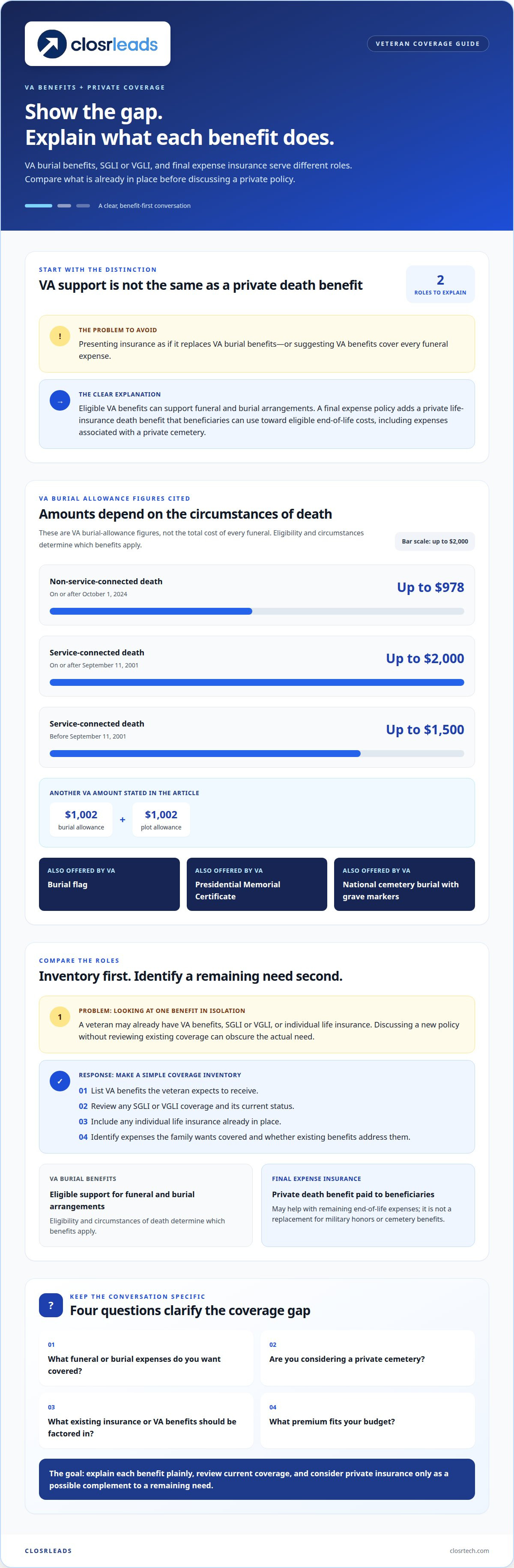
These options serve different roles. VA burial benefits provide eligible support for funeral and burial arrangements. Final expense insurance adds a private life insurance death benefit that beneficiaries can use toward end-of-life expenses. Include SGLI and VGLI in the comparison when a veteran already has coverage through those programs. Review each policy’s benefit, eligibility, and current status before discussing a coverage gap.
The VA allowance depends partly on whether a death is service-connected. For a non-service-connected veteran death on or after October 1, 2024, the VA burial allowance can be up to $978, according to the U.S. Department of Veterans Affairs. The U.S. Department of Veterans Affairs states, “We’ll pay a $1,002 burial allowance and $1,002 for a plot.” For a veteran's service-connected death on or after September 11, 2001, the VA burial allowance can be up to $2,000, according to the U.S. Department of Veterans Affairs. For a veteran's service-connected death before September 11, 2001, it can be up to $1,500, according to the U.S. Department of Veterans Affairs.
Those figures describe VA burial allowances, not the total cost of every funeral. The U.S. Department of Veterans Affairs also offers a burial flag, a Presidential Memorial Certificate, and burial in national cemeteries with grave markers. Eligibility and the circumstances of death determine which VA benefits apply. Explain that distinction before presenting private coverage as a possible complement.
For a practical comparison, list the veteran’s existing VA benefits, SGLI or VGLI coverage, and any individual life insurance. Then identify the expenses the family wants covered and consider whether existing benefits address them. A final expense policy may help fill a remaining need, but it should not be presented as a replacement for military honors or cemetery benefits.
Keep the conversation specific: clarify which benefits the veteran expects, who would receive an insurance death benefit, and what expenses that beneficiary may need to manage. This makes the comparison clearer and supports an honest coverage discussion.
What health questions and underwriting rules apply to veterans buying final expense insurance
Underwriting varies by policy. Some applications ask health questions, while Final Expense+ requires no medical exam or health questions for eligible applicants. When learning how to sell final expense to veterans, explain this difference before discussing a specific plan. A simpler application process does not mean every policy has the same eligibility or benefit terms.
With an underwritten option, guide the veteran through the insurer’s health questions without interpreting answers for them. Ask them to describe their history accurately, including diagnoses and relevant treatment. Don’t assume a service-connected disability automatically determines eligibility. The policy’s underwriting rules determine how disclosed information affects the application.
Discuss cancer history clearly and respectfully. Final expense insurance often accepts applicants with a cancer history after two to five cancer-free years, but that general timeframe does not determine an individual outcome. Ask the applicant to answer the insurer’s questions about treatment and health history directly. Don’t imply that a particular diagnosis guarantees acceptance or rejection.
Before beginning an application, clarify what the veteran wants from the process:
- Explain whether the policy asks health questions or requires a medical exam.
- Give the veteran time to understand each application question and respond accurately.
- Review the policy’s eligibility and benefit terms before the applicant decides.
Most final expense policies accept applicants between ages 50 and 85, while guaranteed-issue coverage has its own eligibility rules. Age alone doesn’t explain which policy fits. Compare the available application process with the veteran’s circumstances and preferences. For eligible applicants, a no-exam, no-health-question option may remove those steps, but explain its terms separately from its application requirements.
An important part of how to sell final expense to veterans is keeping health discussions factual and unhurried. Review the completed answers with the applicant, clarify any misunderstood wording, and let them make the final decision. Accurate answers and clear explanations help keep the application focused and respectful.
How can an agent get licensed and sell final expense insurance to veterans?
Start with authorization, not a pitch. An agent needs the appropriate life-insurance authority for the state where they plan to solicit coverage. Since state requirements differ, map the applicable licensing steps before discussing an application. Also confirm carrier appointment and product requirements. This groundwork keeps the conversation within the agent’s approved scope.
Learn the policy details well enough to explain them without jargon. Review eligibility, health questions, premiums, exclusions, and any reduced initial death benefit. For example, distinguish a guaranteed-issue policy’s application process from its early benefit terms. Veterans should understand both before deciding whether to apply.
- Identify the state where the veteran resides and establish the applicable insurance authority before soliciting a policy.
- Complete the carrier’s appointment and product-specific requirements before presenting its coverage.
- Ask about the veteran’s goals, existing coverage, expected VA benefits, and preferred premium before discussing options.
- Explain the policy’s cost and benefit terms plainly, then let the veteran decide without pressure.
Listen first. Ask what expenses the veteran wants beneficiaries to manage and what coverage they already have. Then explain how a proposed policy fits that need. Don’t suggest that military service automatically qualifies someone for a private policy or guarantees approval.
Discuss costs directly. Show the premium alongside the coverage amount and explain whether the premium stays level under that policy. If the veteran wants time to consider, respect that choice. Follow up by asking whether they have questions or need help understanding a term, rather than whether they’re ready to buy.
Before submitting an application, review the veteran’s answers for accuracy and explain the next steps in plain language. Never complete health responses on their behalf or gloss over a limitation. A disciplined process combines proper licensing, product knowledge, careful listening, and an honest explanation of costs. This lets agents serve veterans without turning a sensitive decision into a pressure close.
ClosrLeads: Final Expense Leads
ClosrLeads offers real-time and aged Final Expense Leads and Veteran Insurance Leads for agents ready to take a clear, needs-based approach with prospective clients. Choose the lead type that aligns with your focus, then learn about the veteran’s coverage goals and explain policy terms honestly.
Fresh leads are delivered in real-time, and aged leads are available in age-based shelves. Leads go to your CRM via webhook or CSV, and the Built-In Dialer gives you a dashboard to work your ClosrLeads leads in one place. IUL leads are also available for agents serving clients with that separate coverage interest.
Turn to these lead options when you’re ready to build a pipeline for final expense conversations with veterans. Contact ClosrLeads to discuss your lead needs.
Build the Next Veteran Conversation
Preparation matters, but progress also depends on connecting with people whose needs match your focus. Keep explanations clear, make room for questions, and let each veteran decide with confidence. A consistent, respectful process supports how to sell final expense to veterans without pressure or one-size-fits-all pitches.
For your next pipeline step, ClosrLeads offers real-time and aged Final Expense Leads, Veteran Insurance Leads, and IUL Leads. Choose the direction that fits your business, then use each conversation to understand what the prospect wants to protect. The goal isn’t a faster pitch. It’s a better-informed discussion with a clear next step.
Contact ClosrLeads to discuss your needs and decide whether its lead options fit your approach. Keep trust, clarity, and thoughtful follow-up at the center. Every veteran deserves a respectful conversation. Move forward with confidence, one useful conversation at a time.
Frequently Asked Questions
What is final expense insurance and who is eligible?
Final expense insurance is life insurance designed to help beneficiaries pay funeral, burial, and related end-of-life expenses. Eligibility depends on the policy’s age limits and application rules. For guaranteed-issue coverage, qualifying ages vary by location: the stated range is 45 to 85, or 50 to 75 in New York. VA burial-benefit eligibility is separate and can depend on discharge status.
What are typical final expense policy costs and coverage amounts for veterans?
Treat these as specific examples, not universal quotes. Compare the premium with the veteran’s budget and intended benefit.