Blog
Trucker insurance cold call script for legal calls and better timing
Use a trucker insurance cold call script to make compliant calls, avoid common mistakes, and reach trucking prospects at better times with a clear next step.

Insurance cold calls can be legal in the US, but only when agents follow the rules. A trucker insurance cold call script should support compliant outreach, not just a fast pitch. The Federal Trade Commission says telemarketing calls may generally be made only between 8 a.m. and 9 p.m. in the called party’s local time, and telemarketers must honor a consumer’s do-not-call request within no more than 10 business days.
That leaves agents with two priorities: get the compliance basics right and make every call count. This guide covers the key rules, common mistakes, practical ways to open a conversation with a trucking prospect, and how to choose a better time to call. You’ll get a clear framework for developing leads and moving from a first hello to a useful insurance conversation, without pressure or filler.
Key Takeaways
- Build a focused opening that identifies who you represent and gives a trucking prospect a clear reason to keep talking.
- Avoid common call mistakes by keeping your message relevant, respecting objections, and recording useful follow-up details.
- Use the prospect’s schedule and renewal timing to shape your outreach, then offer a simple next step instead of pushing for an immediate decision.
- When you need prospects to work, explore ClosrLeads Trucker Insurance Leads as a source for developing your pipeline.
1. Is cold calling for insurance legal in the US?
Insurance cold calls are not automatically illegal in the United States. They must comply with the TCPA and National Do Not Call Registry. State rules and licensing requirements also vary by state and insurance line. According to the Federal Trade Commission, telemarketers must honor a consumer’s do-not-call request within no more than 10 business days. The Federal Trade Commission also requires internal do-not-call suppression records to be retained for 5 years.
Prospect eligibility depends on the number, consent, and relationship with the agency. A consumer on the National Do Not Call Registry may be called if they signed written permission naming the agency and phone number. Existing insurance customers within 18 months are exempt from the registry. For auto-dialed calls to cell phones, the Federal Communications Commission requires prior express written consent under the federal TCPA. State rules may add further restrictions.
Identify yourself, the entity you represent, and a phone number or address where it can be reached. If asked where the number came from, explain its actual source, such as an insurance inquiry or lead record. Don’t guess or give a vague answer. Record a do-not-call request promptly and suppress that number from future calls within the required period.
A trucker insurance cold call script should identify the caller, explain the reason for calling, and invite a brief conversation. Ask whether the prospect currently has auto insurance and who handles the coverage. Then ask what type of vehicle they operate, how it’s used, and when the policy renews. Keep questions relevant to the prospect’s situation.
For example, ask, “Do you currently have coverage for your truck?” Follow with, “Would you be open to reviewing options before renewal?” Let the prospect decide whether to continue. If they decline, respect their answer and update the record. A clear exchange gives the caller a practical next step without pressuring the prospect.
2. Common cold-calling mistakes
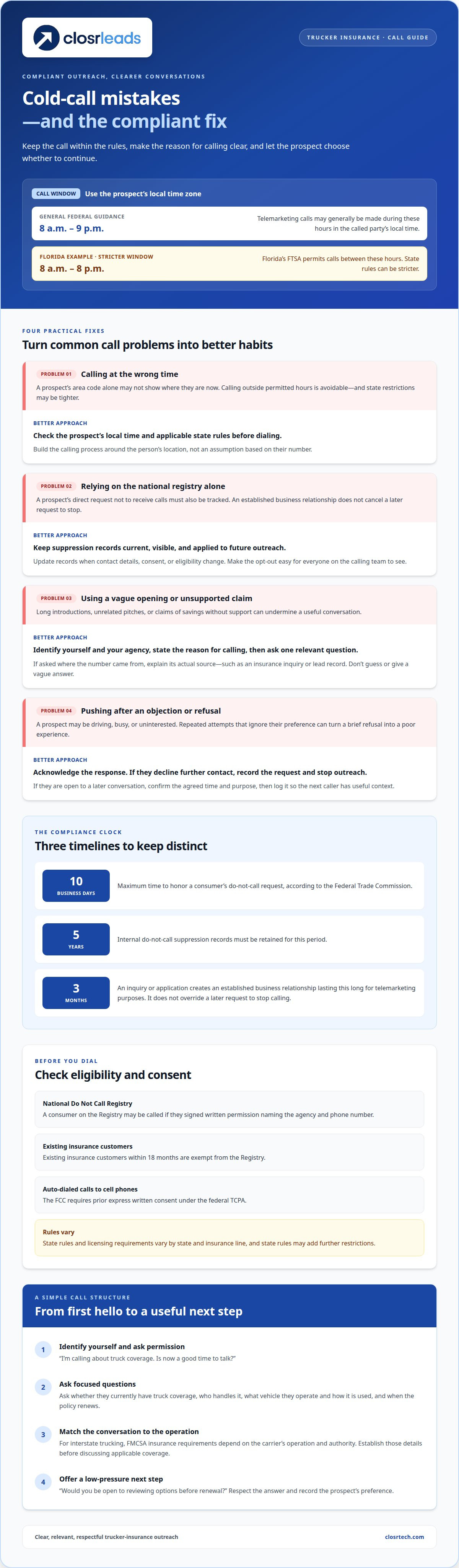
Calling outside permitted hours is an avoidable compliance mistake. The Federal Trade Commission says insurance telemarketing calls may generally be made between 8 a.m. and 9 p.m. in the called party’s local time zone. State rules can be stricter. Florida’s FTSA permits calls between 8 a.m. and 8 p.m. Build the prospect’s local time and applicable state restrictions into the calling process. A number’s area code alone may not establish where the prospect is now.
Another mistake is treating the national Do Not Call Registry as the only suppression record. Track a prospect’s direct request not to receive calls, then apply it to future outreach. Keep records current when contact details, consent, or eligibility change. An inquiry or application creates an established business relationship lasting 3 months for telemarketing purposes. That relationship doesn’t erase a later request to stop calling. A reliable process keeps suppression records visible to everyone making calls.
Weak openings waste the prospect’s attention. Avoid long introductions, vague claims, and several unrelated product pitches. State your name, the agency you represent, and the reason for calling. Then ask one relevant question, such as whether the prospect is open to discussing truck coverage. Don’t claim savings without support or imply that a quote is ready before gathering the necessary details. Clear, accurate language gives an interested prospect room to continue talking.
Don’t treat a quick refusal as permission to push harder. If the prospect says they’re driving, busy, or uninterested, acknowledge it. Ask whether another time works only when appropriate. If they decline further contact, record the request and stop outreach. Avoid repeated attempts that ignore state limits or the prospect’s preference. Before scheduling an appointment, confirm the agreed time and purpose. A concise call record helps the next caller avoid repeating questions or contacting someone who opted out.
3. Sales training and lead generation for trucking insurance agents
Training starts with a repeatable sales call, not a memorized speech. Whether reaching out on behalf of an independent agency like All Insurance or a larger brokerage, agents must clearly identify themselves and the agency they represent. Then they state why they’re calling and ask permission to continue. For example: “I’m calling about truck coverage. Is now a good time to talk?” This direct opening respects a busy operator’s time and creates room for a useful conversation. The Federal Trade Commission says insurance telemarketing calls may generally be made only between 8 a.m. and 9 p.m. in the called party’s local time zone.
For interstate trucking, FMCSA insurance requirements depend on the carrier’s operation and authority. Establish those details before discussing applicable coverage rather than giving every prospect the same answer. Commercial coverage requirements often vary by jurisdiction and carrier size; for example, full-service providers like The Lewis Agency Central Texas insurance focus on matching specific vehicle operations with compliant liability and cargo limits. Ask who handles the business insurance, what operation the policy covers, and when it renews. Keep the conversation focused on the prospect’s stated needs, not assumptions about their vehicle or route.
Build lead generation around relevant prospects and clear follow-up. During practice, have agents role-play objections such as “I already have insurance” or “I’m driving.” A useful response acknowledges the objection, then asks whether a later conversation would help. If the prospect isn’t interested, close politely and record the outcome. If they are interested, agree on a follow-up time and purpose, such as discussing renewal options.
AI agents can help teams rehearse openings, practice objections, or review call notes. They shouldn’t make unsupported coverage claims or override a prospect’s request to stop. The Federal Communications Commission says prerecorded or artificial-voice calls require prior express written consent. This rule matters when outbound calls use an artificial voice. Keep human agents responsible for understanding the prospect’s situation and deciding the next step.
Close with a specific, low-pressure action: “Would you prefer to discuss this before renewal, or should I follow up later?” Confirm the prospect’s preference and log it. A consistent process helps insurance agents improve each sales call without turning follow-up into unwanted pressure.
4. What's the best time to cold call insurance prospects?
Timing can improve the chance of a useful conversation, but the prospect’s schedule matters. A HubSpot-cited recommendation identifies 8 to 9 am and 4 to 5 pm as good cold-calling windows. Personal-lines insurance prospects may be more reachable between 5:30 and 7 PM local time. For trucking accounts, test permitted windows against the prospect’s operating routine, then record which time earned a response.
Objections often reveal why a prospect hesitates. “I already have coverage” may mean they’re satisfied or simply busy. Ask one calm follow-up: “Understood. When does your policy renew?” If they’re not interested, don’t turn the answer into a debate. Acknowledge it, offer a later conversation only if welcomed, and respect a request to stop calling.
Income-protection objections call for a different approach. A prospect may say, “I can’t afford another expense,” or “My business already has insurance.” Don’t promise savings or suggest one policy replaces another. Ask what concern matters most, then explain only how the conversation could address that stated need. If they’re driving or handling a delivery, offer to call at a time they choose.
Strong calling scripts prepare agents for common objections without making them sound robotic. Use a simple sequence: listen without interrupting, reflect the concern, ask permission to discuss one relevant detail, and agree on a next step. For example: “You’re covered now. Would it help to review options before renewal?” If the prospect says no, close courteously. If they’re interested, confirm the appointment time and topic. Log the actual response so the next caller doesn’t repeat the same pitch.
Keep a call record by time of day, objection, and outcome. Review those entries to identify productive windows for your agency, rather than assuming one schedule suits every prospect. Build a stronger trucking prospect pipeline when your team needs more relevant conversations to work.
ClosrLeads: Trucker Insurance Leads
ClosrLeads provides Trucker & CDL insurance leads for agents who need relevant prospects to support consistent outreach. Choose Fresh, real-time leads or Aged leads to suit your follow-up approach. Every Fresh lead is OTP phone-verified and TCPA-compliant, with a replacement guarantee for invalid contacts. Leads are delivered to your CRM by webhook or CSV, and ClosrLeads’ built-in dialer lets you work your leads from one dashboard.
Use these leads when your team is ready to work new trucking prospects and apply the compliant calling practices covered above. They can support a focused pipeline, while your script and follow-up process guide each conversation. ClosrLeads also offers Final Expense Leads, Veteran Insurance Leads, and IUL Leads for agents working in those insurance lines.
For trucking prospects to work, contact ClosrLeads to discuss Trucker Insurance Leads.
Turn better calls into a stronger pipeline
A repeatable process gives each conversation a clear purpose. Review call outcomes, refine your opening, and use prospect responses to shape follow-up. A trucker insurance cold call script works best as a flexible guide, not a rigid pitch. Keep the language direct, make room for questions, and let each prospect’s priorities steer the discussion.
Consistent prospecting also depends on having a pipeline your agents can actively work. ClosrLeads offers insurance leads across several lines, including Final Expense, Veteran, and IUL. Choose the next move that fits your team’s focus, then bring a clear follow-up process to every conversation.
Contact ClosrLeads to discuss lead generation and take the next step toward a more focused outreach process. Keep improving each call, and build momentum one meaningful conversation at a time.
Frequently Asked Questions
Is cold calling for insurance legal in the US?
Yes, insurance cold calls can be legal when the caller follows applicable federal and state requirements. For example, the Federal Trade Commission says telemarketers must honor a consumer’s do-not-call request within no more than 10 business days and retain internal suppression records for 5 years. Before dialing, consider the prospect’s consent, registry status, calling method, and state rules.
What's the best time to cold call insurance prospects?
Try different permitted calling windows and track which ones lead to useful conversations. A HubSpot-cited recommendation identifies 8 to 9 am and 4 to 5 pm as good cold-calling times. For personal-lines prospects, 5:30 to 7 PM local time is another suggested window. Trucking prospects may have different work routines, so use their stated preferences to guide follow-up.
What questions should an agent ask to qualify a trucking insurance prospect?
Start with questions that reveal the prospect’s operation and timing: “What kind of trucking do you do?” and “When does your current policy renew?” Ask who handles the insurance and whether they want to discuss coverage options. If they’re open to continuing, clarify their preferred follow-up method and time. Keep questions relevant rather than turning the opening into an application.
How can agents identify a trucker's insurance needs and current coverage?
Ask the trucker to describe their current policy in their own words, including the business activity it covers and any concerns they have. Then ask whether their routes, equipment, or operations have changed since coverage began. For example, a shift from local hauling to longer routes may prompt a review. Don’t assume a specific coverage gap based on truck type alone.
How should an agent handle common objections to truck insurance cold calls?
Listen first, then respond to the actual concern without arguing. If a prospect says, “I already have coverage,” ask whether they’d like to revisit options near renewal. If they’re busy, offer to follow up at a time they choose. If they decline or ask you to stop calling, end politely and record their preference. Avoid unsupported savings claims or pressure tactics.