Blog
Veteran insurance needs analysis questions for marriage and household changes
Use veteran insurance needs analysis questions to compare flexibility, underwriting, household changes, and long-term affordability before choosing coverage.

The lowest premium isn’t automatically the best fit. The most useful veteran insurance needs analysis questions compare policy flexibility, medical underwriting, household changes, and whether premiums will remain affordable over time. They help clarify how coverage fits your needs now and as your family or finances change.
Marriage, a new child, divorce, or a change in income can affect who depends on your coverage and how much protection your household needs. It’s easy to focus on the benefit amount and overlook policy terms that may matter later.
Use these focused questions when comparing coverage options. Ask about changing or converting a policy, how health and service-connected disabilities may factor into underwriting, which household changes to consider, and how to assess long-term affordability. The goal is a clearer comparison, not a one-size-fits-all answer.
Key Takeaways
- Compare how each policy handles future coverage changes, conversion, and portability before choosing based on premium alone.
- Ask how medical underwriting considers your health history and service-connected disability rating.
- Reassess who depends on your coverage and what protection the household needs after marriage, divorce, or another major change.
- Test whether premiums remain manageable over time, especially if the policy’s costs can change as you age.
Policy flexibility, conversion, and future coverage changes
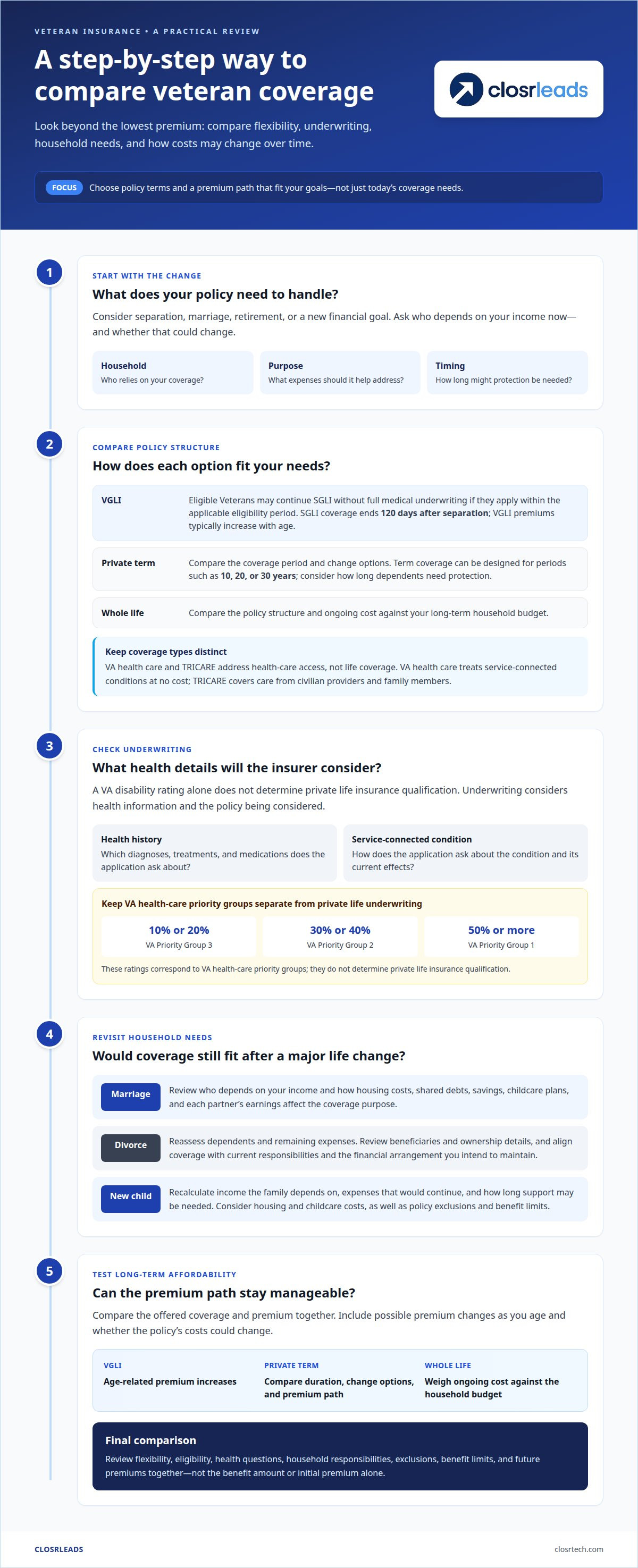
Start with the change you need the policy to handle: separation, marriage, retirement, or a new financial goal. Eligible Veterans who apply for VGLI within the applicable eligibility period may continue SGLI coverage without full medical underwriting. SGLI coverage ends 120 days after separation from military service. VGLI premiums typically increase with age, so include future affordability in the comparison.
VGLI differs from private term and whole life insurance in its program rules and policy structure. Term coverage can be designed for periods such as 10, 20, or 30 years; compare each option’s duration, flexibility, and premium path against your family’s needs.
| Option | Flexibility to compare | Useful decision factor |
|---|---|---|
| VGLI | Continuation and age-related premiums | Eligibility period after separation |
| Private term | Coverage period and change options | How long dependents need protection |
| Whole life | Policy structure and ongoing cost | Long-term household budget |
| VA health care | Health-care access, not life coverage | Eligibility and care needs |
| TRICARE | Civilian-provider and family coverage | Retiree and household circumstances |
Choose the option whose terms and premium path match your goals, not just today’s coverage needs.
For health, disability, long-term care, and burial expenses, separate the needs: review health coverage, income protection, future care costs, and final expenses. VA health care counts as minimum essential coverage under the Affordable Care Act, although it isn’t a health insurance program. According to the U.S. Department of Veterans Affairs, it recommends that veterans using VA health care enroll in Medicare Part B at age 65; later enrollment may bring a lifetime late-enrollment penalty. For guidance on navigating Medicare enrollment alongside veteran benefits, resources like medicarementors.com can help clarify retirement health planning options.
VALife and VGLI are separate VA life insurance programs, so assess each program’s eligibility rules independently. For VGLI, eligible Veterans must apply within the applicable eligibility period to continue SGLI without full medical underwriting. The U.S. Department of Veterans Affairs identifies at least 30 days of service at Camp Lejeune between August 1, 1953, and December 31, 1987, as a further VA health care eligibility factor.
Military retirees may have both VA health care and TRICARE. VA treats service-connected conditions at no cost, while TRICARE covers care from civilian providers and family members. Include a spouse’s or children’s coverage needs in your household plan. Renters should also consider whether personal property coverage fits their belongings and finances.
Medical underwriting and service-connected disabilities
A VA disability rating does not automatically prevent a Veteran from qualifying for private life insurance. Underwriting considers the applicant’s health information and the policy being considered. A service-connected condition may matter, but the rating alone doesn’t determine the outcome. Compare the insurer’s questions about diagnosis, treatment, medications, and daily effects. Answer accurately, then assess the offered coverage and premium together.
VA health care priority groups use disability ratings as one eligibility factor. Veterans with a combined service-connected evaluation of 10 or 20% are listed in Priority Group 3. A combined evaluation of 30 or 40% corresponds to Priority Group 2, while 50% or more corresponds to Priority Group 1. These groups relate to VA health care, not private life insurance qualification. Keep those decisions separate when comparing protection.
A new child changes your household’s financial picture. Recalculate how much income the family depends on, which expenses would continue, and how long support may be needed. For life insurance, consider whether the benefit could help a surviving spouse manage housing, childcare, and other household costs. For disability coverage, consider how lost earnings could affect those obligations. Compare policy definitions and exclusions, not just the headline benefit.
Use a focused underwriting checklist before deciding:
- Health history: Which diagnoses, treatments, and medications does the application ask about?
- Service-connected disability: How does the application request details about the condition and its current effects?
- Family change: Would the proposed coverage still fit if childcare or housing costs rise?
- Policy terms: What exclusions, benefit limits, and premium changes apply?
For agents serving veterans who are weighing coverage after a family change, Veteran Insurance Leads can support conversations with prospective applicants.
Marriage, divorce, and household changes
Marriage can change who depends on your income and how household expenses are shared. Revisit the purpose and amount of life coverage when a spouse becomes part of your financial plan. For example, consider whether the surviving spouse could manage housing costs without your income. Include shared debts, savings, childcare plans, and each partner’s earnings in the discussion. A policy suited to an individual household may need a different role after marriage. For individuals balancing property debt with family security, independent advisers like Lee Tonks: Mortgage Guru demonstrate how coordinating mortgage and protection advice helps safeguard household stability.
Divorce also changes your household finances. Reassess who relies on your income, which expenses remain yours, and whether existing coverage still supports your goals. Review beneficiaries and ownership details as part of the policy review. For example, a veteran who previously planned around a spouse’s financial needs may now prioritize children or another dependent. Align coverage with your current responsibilities and the financial arrangement you intend to maintain.
Review auto coverage separately. Married couples may bring two cars into the relationship, each with different uses, drivers, and existing protection. They may also have policies from two insurance companies. Compare the coverage options together before deciding whether to change the household arrangement. A move, a new driver, or a change in commuting can also affect practical needs.
Use these prompts to structure your review after a major change:
- Income: Which household expenses depend on your earnings, your spouse’s earnings, or both?
- Dependents: Who would need financial support if your circumstances changed?
- Existing policies: What coverage, beneficiaries, and responsibilities need a fresh review?
- Vehicles: How do the two cars, drivers, and policies from two insurance companies fit together?
- Future plans: Would a move, childcare change, or revised budget alter the protection your household needs?
After marriage or divorce, revisit your answers whenever household responsibilities shift. Connect each policy to a specific need, such as income replacement for a spouse, support for children, or protection for shared obligations. Keep auto and life coverage decisions distinct, then consider how both fit the household budget.
Premium changes and long-term affordability
Assess a policy by its premium path, not just its first payment. VGLI premiums typically increase with age, so consider whether the coverage will remain affordable as your budget changes. Compare the premium schedule with expected income, household obligations, and how long your family may need protection. A policy that fits today’s budget may become a strain if costs rise or income falls.
Ask how the premium is set and what could change it. Then compare the written schedule for each option. Compare nearby coverage amounts, rather than assuming a larger benefit will always cost more.
Check affordability against your actual finances. List recurring household expenses, existing coverage payments, and income available for premiums. For example, a veteran approaching retirement can compare the proposed premium with expected retirement income, not just current earnings. Leave room for essential expenses and changes such as housing costs or supporting a family member.
- Premium pattern: Does the schedule stay level, rise with age, or change under stated policy terms?
- Coverage fit: Does the benefit still match the household need as dependents become more financially independent?
- Budget resilience: Could the premium remain manageable if income changes or other expenses increase?
Review the comparison after a major change in income, retirement plans, or family responsibilities. Keep policy documents and the premium schedule together, then reconsider whether the benefit and ongoing cost still serve the same purpose. If affordability becomes tight, compare available policy terms before making changes that could reduce protection.
Insurance professionals helping veterans assess long-term affordability can explore veteran insurance lead options for relevant conversations.
ClosrLeads: Veteran Insurance Leads
ClosrLeads provides Veteran Insurance Leads for insurance professionals connecting with veterans considering coverage. Use these leads when you’re ready to apply the policy-flexibility, underwriting, household, and affordability questions in client conversations. ClosrLeads also offers Final Expense Leads and IUL Leads for related insurance needs.
Every lead is OTP phone-verified and TCPA-compliant. Real-time leads are delivered to your CRM via webhook or CSV, and aged leads are available in shelves. The Built-In Dialer helps you work ClosrLeads leads from one dashboard. These tools support outreach; coverage comparisons and recommendations remain part of your client discussions. Choose the lead type that matches your focus, then center each conversation on the veteran’s household needs and coverage goals.
Contact ClosrLeads to discuss Veteran Insurance Leads.
Put your next coverage conversation in motion
Record the decision clearly. Note the household goal, the tradeoffs you considered, and what would prompt another review. This gives you and your spouse a shared reference point when plans change and keeps future conversations focused on priorities.
For insurance professionals, thoughtful veteran insurance needs analysis questions can turn a broad discussion into a focused conversation about a veteran’s priorities. Use each answer to understand what matters and align the next step with that need. ClosrLeads offers Final Expense Leads, Veteran Insurance Leads, and IUL Leads to support professionals serving these insurance audiences.
Contact ClosrLeads to discuss your needs and take the next step with a clear purpose. Strong conversations start with listening, and your next one can start today.
Frequently Asked Questions
What insurance coverage do veterans typically need?
Veterans often assess life, health, disability, and property coverage against their household responsibilities. The right mix depends on existing benefits, family needs, debts, and savings. For example, a veteran with dependents may focus on income protection, while a renter may consider coverage for personal belongings. Assess health-care access separately from life insurance, since each addresses a different financial risk.
How can veterans assess their life insurance needs?
Start by identifying who would rely on your income and which expenses would remain if you died. Consider housing, debts, childcare, education goals, and final expenses, then account for savings and existing life coverage. A veteran whose spouse contributes income may have different needs from a sole earner. Review the estimate after major changes, such as retirement or a new dependent.
How much life insurance should a veteran have based on income and dependents?
No single coverage amount fits every income or family size. Estimate how much financial support dependents may need, how long those obligations could continue, and what resources are already available. For example, a veteran supporting a child and sharing housing costs may need a different benefit from someone whose dependents are financially independent. Revisit the estimate as income, savings, and family responsibilities change.
What health conditions or disabilities affect veterans' life insurance eligibility and rates?
A VA disability rating alone doesn’t automatically prevent a veteran from qualifying for private life insurance. An application may consider health history and details about a condition, including treatment and its effects. The policy terms and premium offered depend on the underwriting assessment. Provide complete, accurate application information so the insurer can assess the actual circumstances rather than relying on the rating alone.
What questions should veterans ask when reviewing insurance coverage with a financial adviser?
Ask which financial need each policy addresses, how long that need may last, and what premium changes or exclusions apply. A focused set of veteran insurance needs analysis questions should also cover how a policy fits with existing benefits, family plans, and future income. Ask the adviser to explain the tradeoffs between options in plain language, then record the reasons for your decision so you can review them later.